9 Top RankYak Alternatives for Automated Content Generation
You are paying for an automated content tool and still editing every draft by hand. That gap between what the tool promises and what lands in your publishing queue is why so many writers and agencies start hunting for a replacement within weeks. Some platforms cap your output, some bury the useful features behind upgrades, and others simply produce text you cannot publish.
This article lays out nine RankYak alternatives and the criteria that actually separate them: output volume, editing time, and price per article. You will see which tool earns the top spot, how the rest compare, and how to pick one that fits your workflow instead of adding another subscription you abandon.
What to Look For in RankYak Alternatives for Automated Content Generation
When evaluating RankYak alternatives, prioritize platforms that offer robust automated content generation capabilities, seamless SEO integration, and scalable pricing to match your content volume. The right choice depends less on marketing claims and more on how well a tool fits your existing workflow.
Start with content quality. Look for AI writing tools built on modern natural language processing and machine learning algorithms, ideally with support for GPT-3, GPT-4, or comparable LLM backends. Output should read naturally, follow instructions, and hold a consistent tone across long-form pieces.
Test how each platform handles prompt control. Tools that let you set tone, audience, structure, and outline depth tend to produce more usable drafts than one-click generators.
- Model support: GPT-3, GPT-4, Claude, Gemini, or proprietary LLMs
- Output control: tone, length, headings, and outline options
- Editing: built-in paraphrasing tool or rewrite functions
- Quality checks: plagiarism checker and readability score
Ease of use matters just as much. A steep learning curve slows down blog post automation and discourages team adoption. A clean editor, clear templates, and sensible defaults usually beat feature-heavy dashboards that require training.
Integration options decide whether a tool fits your stack. Check for WordPress publishing, Zapier or Make connections, and API access if you plan to scale. Tools that plug into existing content marketing software reduce manual copy-paste work.
Pricing models vary widely. Credit-based plans suit occasional users, while unlimited or seat-based plans make more sense for high-volume teams. Compare the cost per published article, not just the sticker price.
| Criterion | What to Check |
|---|---|
| Content quality | NLP and LLM support, tone control, editing tools |
| Ease of use | Editor layout, templates, onboarding time |
| Integrations | WordPress, Zapier, API access |
| Pricing | Credits vs. unlimited, cost per article |
| Scalability | Bulk generation, multi-site support |
| SEO features | Keyword research, SERP analysis, semantic SEO |
Scalability separates hobby tools from production platforms. If you publish daily or manage multiple sites, bulk generation, queue management, and consistent output quality across hundreds of articles become non-negotiable.
Finally, weigh the SEO layer. SERP analysis helps you understand what already ranks, while semantic SEO features like topic clustering and entity extraction align your content with search intent. Keyword research built into the platform saves time and keeps strategy connected to drafting.
Research suggests that pages matching search intent and covering related entities tend to perform better than keyword-stuffed copy. Choose alternatives that support that approach rather than fighting it.
1. Autoblogging.ai - Best Overall
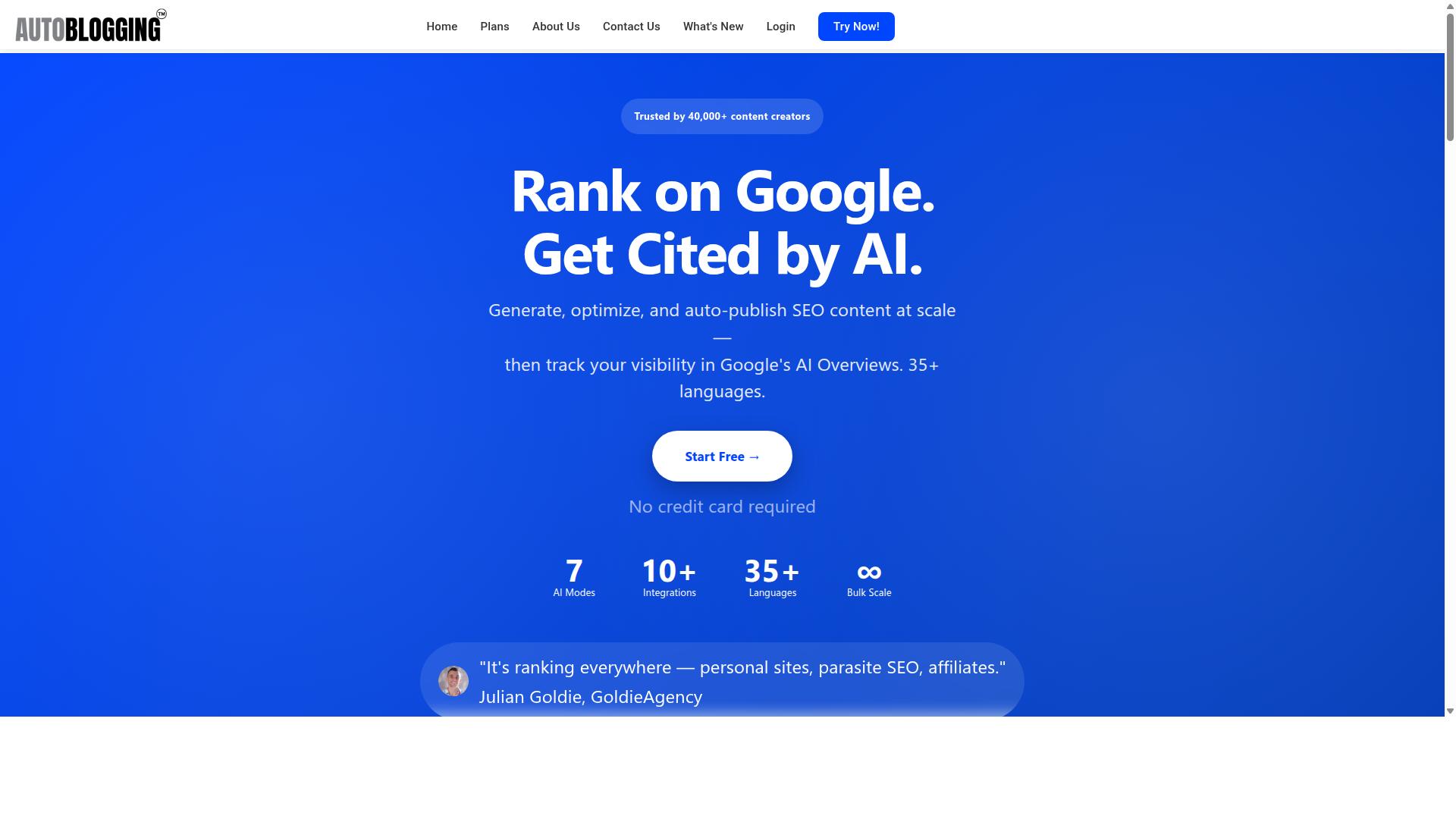
Autoblogging.ai stands out as the best overall RankYak alternative, trusted by over 40,000 content creators and generating more than 1 million articles. It combines automated content generation with SEO content optimization tools in a single platform.
The platform supports 10+ AI modes, 35+ languages, and 35+ integrations, making it a strong fit for bloggers, agencies, and affiliate marketers working across multiple markets. Global availability means teams can produce content in the language their audience actually reads.
Unlike many AI writing tools that stop at text generation, Autoblogging.ai also covers publishing and optimization. WordPress integration supports unlimited sites with one-click publishing, a plugin, and scheduled auto-posting.
Content can also be sent to Web 2.0 platforms such as Medium, Dev.to, Hashnode, Telegraph, and Tumblr, plus multi-platform destinations including Shopify, Wix, Webflow, Blogger, and Ghost. API, Zapier, and n8n connections handle custom workflows.
Key Features, Pricing, and Modes
Autoblogging.ai offers a range of modes including Quick Mode for free single articles, Godlike Mode with SERP competitor analysis and LSI keyword extraction, and Bulk Generation for up to 500 articles at once. Each mode targets a different stage of automated content generation.
Quick Mode covers free single articles and a wizard for guided setup. Godlike Mode adds SERP competitor analysis, LSI keywords, and knowledge graph extraction for deeper SEO content optimization. Bulk Generation accepts CSV uploads for large-scale blog post automation.
Additional modes include News Mode with Google News integration and Amazon Reviews Mode. A Content Repurposer and a set of optimization tools round out the platform:
- Site Optimizer and Intense Optimizer
- Semantic SEO Analysis (21-point audit)
- Snippet Optimizer and Topical Maps
- Fan Out Queries and AI Infographics
- Outreach Prospects
- AI Proofreader and Human Proofreader
Pricing starts at $19 per month for Starter with 40 credits and scales to $999 per month for Enterprise with 5,000 credits. The full monthly lineup includes Regular $49 (120 credits), Standard $99 (300 credits), Gold $179 (600 credits), and Premium $249 (1,000 credits).
Annual plans reduce the effective rate: Starter $12/mo ($148/year), Regular $32/mo ($382/year), Standard $64/mo ($772/year), Gold $116/mo ($1,396/year), Premium $162/mo ($1,942/year), and Enterprise $649/mo ($7,792/year). All plans include credits rollover, and new accounts receive 10 free credits per month with no credit card required.
Done For You packages are available for teams that prefer managed delivery: Starter $1,200, Pro $1,600, Corp $4,000, and Senpai $10,000, each covering 1,000 articles. Payments are accepted via Visa, MasterCard, American Express, and PayPal, with bank transfers for annual enterprise plans through Stripe. Cancel anytime.
2. Article Forge

Article Forge is a well-known automated content generation tool that uses deep learning to produce unique articles on any topic. It has been part of the AI writing tools landscape for several years, which gives it a level of name recognition among bloggers and content marketers exploring RankYak alternatives.
The core appeal is straightforward. A user enters a keyword or topic, and the software generates a full article without manual drafting. The platform leans on machine learning algorithms to build sentences from scratch rather than spinning existing text, which separates it from older article spinner tools.
WordPress integration is one of its more frequently mentioned conveniences. Instead of exporting a file and uploading it manually, users can often push drafts directly to a site. For anyone running blog post automation at volume, that shortcut removes a repetitive step.
Pricing follows the subscription model common across this category, with tiers typically tied to word count or article volume. Exact figures shift over time, so check the vendor's current page before budgeting. Most content marketing software in this space structures plans the same way.
Strengths and trade-offs tend to look like this:
- Pros: fast draft generation, direct publishing options, and output that usually passes a plagiarism checker
- Cons: articles can read generically, and editing is often needed to add depth, original insight, or brand voice
Where it fits best is early-stage drafting. Teams that need a starting point for keyword research driven topics can generate a base article, then layer in SEO content optimization and factual review. Treating it as a first draft engine rather than a finished product is the practical approach.
Compared with newer tools built on GPT-3 or GPT-4 style models, Article Forge tends to be judged on reliability and simplicity rather than stylistic flair. It does not aim to match Jasper AI or Copy.ai on marketing copywriting features, and it is not a paraphrasing tool or readability score checker either. Its lane is bulk article creation.
For anyone weighing alternatives, the honest summary is this: Article Forge is a solid, established option for generating articles at scale, provided expectations around editing and originality are set correctly. It rewards users who pair text generation with human review.
3. AutoPost
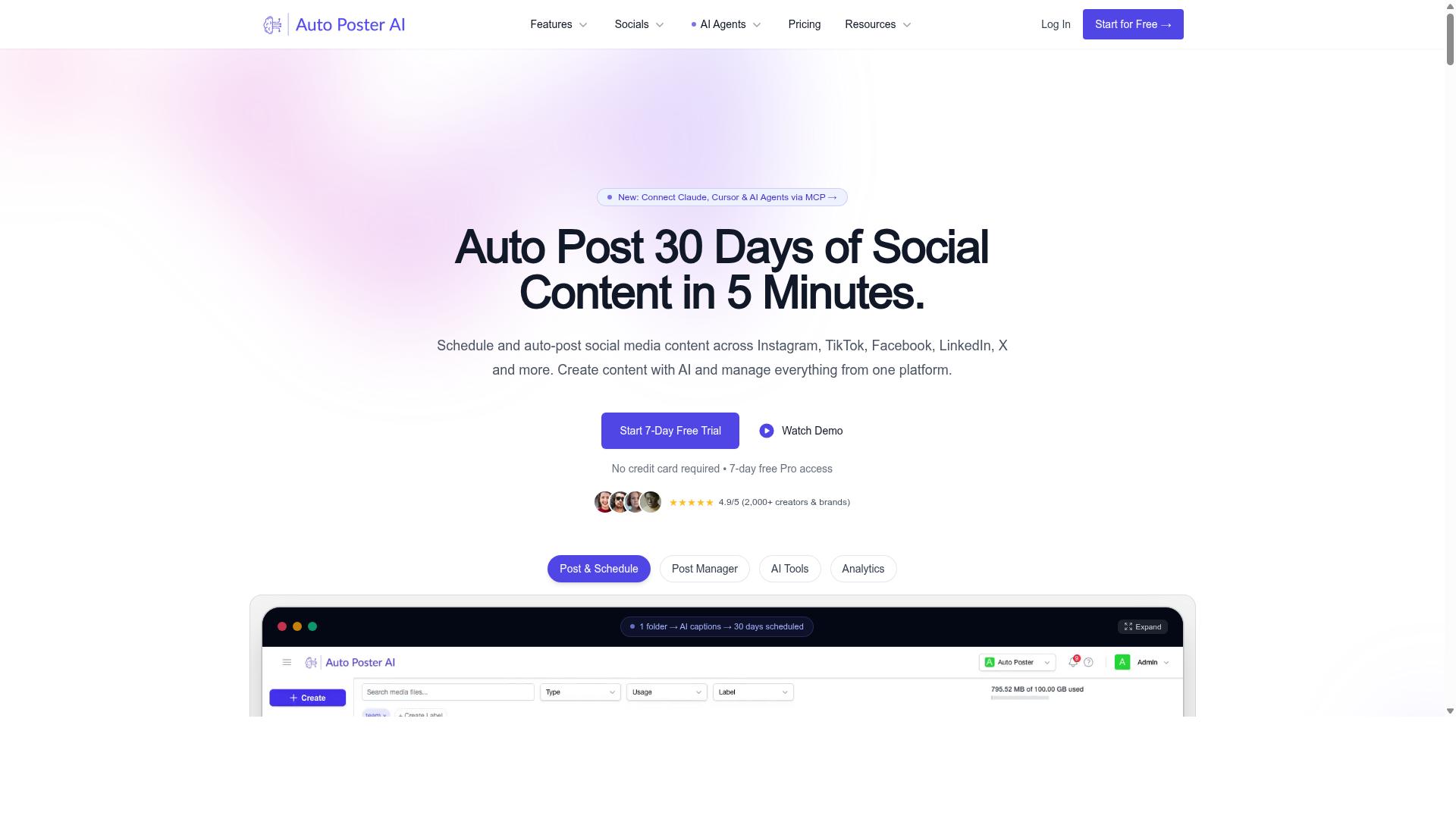
AutoPost is an AI-powered tool designed to automate blog post creation and publishing, often used for niche sites and affiliate marketing. It fits into the broader category of blog post automation platforms that turn a keyword list into finished drafts without a writer touching every step.
Typical setups rely on connecting your own OpenAI key, which means the text generation runs through models you already have access to. That approach gives users more control over cost and output style than tools that bundle AI credits into a subscription.
Publishing usually happens through a direct WordPress connection. Many plugins in this space authenticate with an application password, so posts can be pushed to a site without manual copy and paste. Some tools offer a free trial so you can check output quality before committing.
Beyond the AI key and WordPress link, the workflow tends to revolve around a few core inputs:
- Target keywords that define what each post should cover
- Post settings such as length, structure, and publishing schedule
- AI prompts that shape tone, formatting, and the angle of the article
This keyword-to-post pipeline is what makes AutoPost appealing for affiliate marketing and niche site owners who need volume. Instead of drafting each article by hand, you feed in a list and let the tool produce drafts on a schedule.
Pricing across this category varies widely. Some products advertise entry plans in the range of tens of dollars per month, while others sit higher. AutoPost's specific tiers are not widely published, so it is worth checking the vendor page directly before you commit.
The target user is generally a marketer, agency, or blogger scaling content across multiple sites. One caution worth noting: some users advise against running auto-generated posts on important, established websites, since quality can be inconsistent. For lower-stakes properties or testing, the tradeoff may be more acceptable.
If you are comparing AutoPost against RankYak and other AI writing tools, look at how much control you get over prompts, whether you supply your own API key, and how cleanly it connects to WordPress. Those three factors tend to matter more than headline feature lists.
4. theStacc
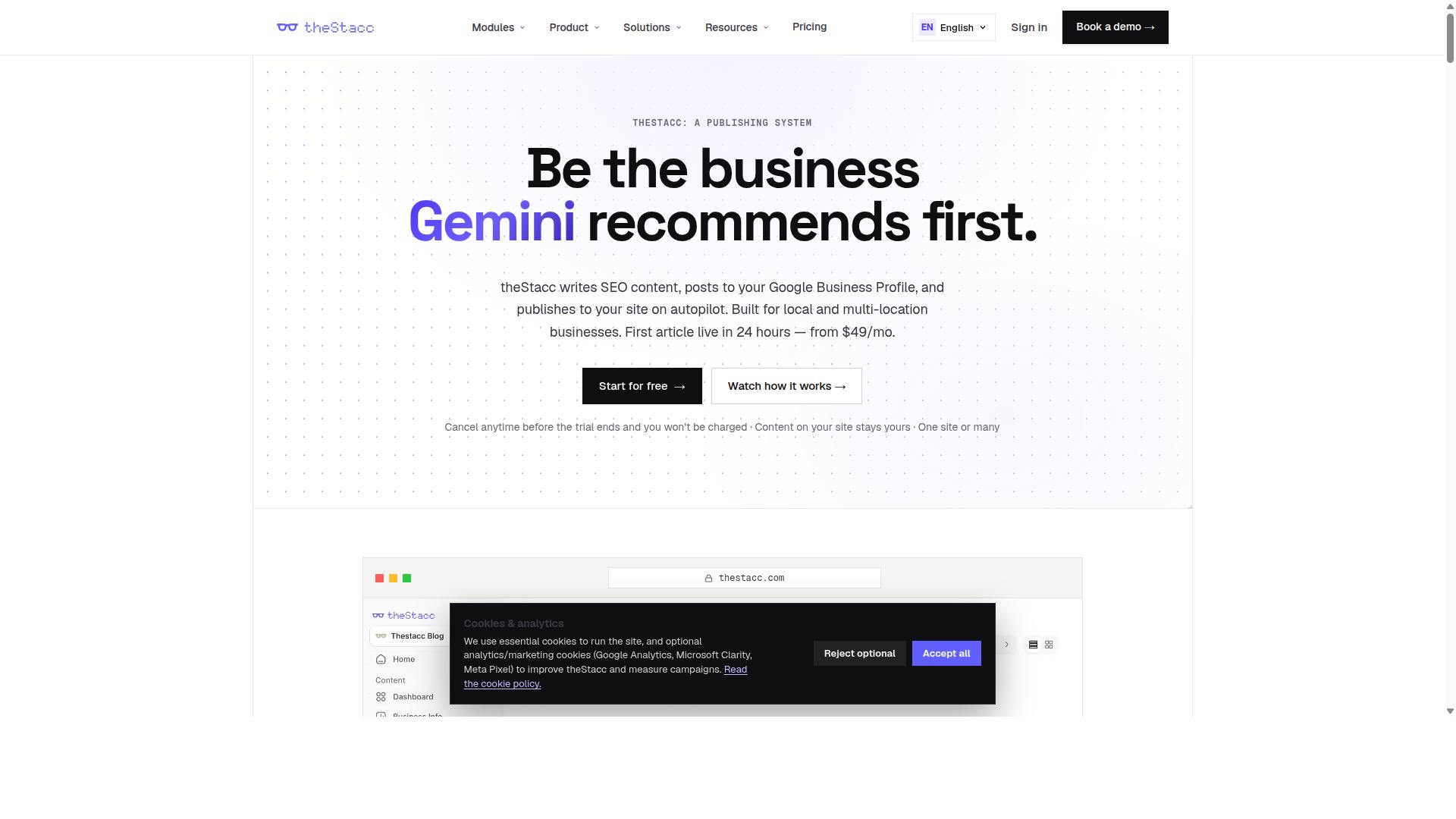
theStacc is a lesser-known automated content generation platform that focuses on creating SEO-friendly articles using AI. Rather than positioning itself as a standalone writing assistant, it bundles content creation into a broader SEO platform with separate modules for Blog SEO, Local SEO, and Social Media.
That structure makes it appealing to teams that want content production and optimization in one place, instead of stitching together several disconnected AI writing tools.
Its Blog SEO module is the part most relevant to automated content generation. It combines an AI Blog Writer with Live SEO Scoring, Brand Voice controls, Auto-Publish, a Content Calendar, Internal Linking, AI Keyword Strategy, and Content Indexing.
In practice, that means a user can plan topics, generate drafts, score them against SEO signals, and push finished posts live without leaving the platform. The Brand Voice feature is a notable addition, since consistent tone is often the weak point of bulk AI output.
For agencies juggling multiple clients, the Local SEO and Social Media modules extend the same workflow beyond blog posts.
- Local SEO: GBP Management, GBP Posts, Review Monitoring, Review Replies, Local Rank Tracking, Review Requests, and Profile Audit
- Social Media: Social Scheduling, AI Image Generation, Content Repurposing, and Multi-Platform Publishing
- Integrations: WordPress, Webflow, Ghost, Google Business Profile, Search Console, and Google Analytics
The integration list matters for blog post automation. Direct connections to WordPress, Webflow, and Ghost support publishing workflows, while Search Console and Google Analytics feed performance data back into the platform.
Pricing sits in two tiers. Software plans start "from US$49/month while Managed Services start "From $749 / mo" for teams that want the work handled rather than just the tooling.
theStacc appears best suited to agencies, multi-location businesses, franchises, and small businesses. The combination of local SEO, social publishing, and blog automation covers several content marketing software needs at once.
The trade-off is that its AI writing features live inside a larger SEO suite. Anyone wanting a dedicated, single-purpose text generation tool may find the broader scope more than they need.
5. Outrank
Outrank is an AI-driven content generation tool that helps users create long-form articles and blog posts quickly. It bundles keyword research, article generation, and scheduled publishing into a single subscription, which positions it as an all-in-one option for bloggers and marketers who want to reduce the number of separate tools in their stack.
Rather than treating writing as a standalone task, Outrank connects research to publishing. Users can generate content, queue it for delivery, and push it straight to their CMS on a schedule. For anyone managing blog post automation across one or more sites, that workflow can cut down on manual steps.
Pricing follows a subscription model. The company lists an All-in-One plan at $99/month or $999/year, which covers 30 auto-published articles per month, automated keyword research, backlink exchange access, AI images, and unlimited users. Higher volumes are sold as add-ons, with 60 articles per month adding $85 and 90 adding $160.
Two extras sit outside the base plan. Human editing is offered as a separate service at $1,399/month, and multi-site accounts receive automatic discounts in the 10 to 20 percent range. The Backlink Exchange lets users earn credits by hosting relevant backlinks and spend those credits to receive them, with verification handled automatically.
Outrank tends to appeal to bloggers, affiliate publishers, and content marketers who value a predictable monthly output over granular control. Teams that prefer to review every draft before it goes live may find the automated publishing angle less useful than the generation side.
6. BabyLoveGrowth
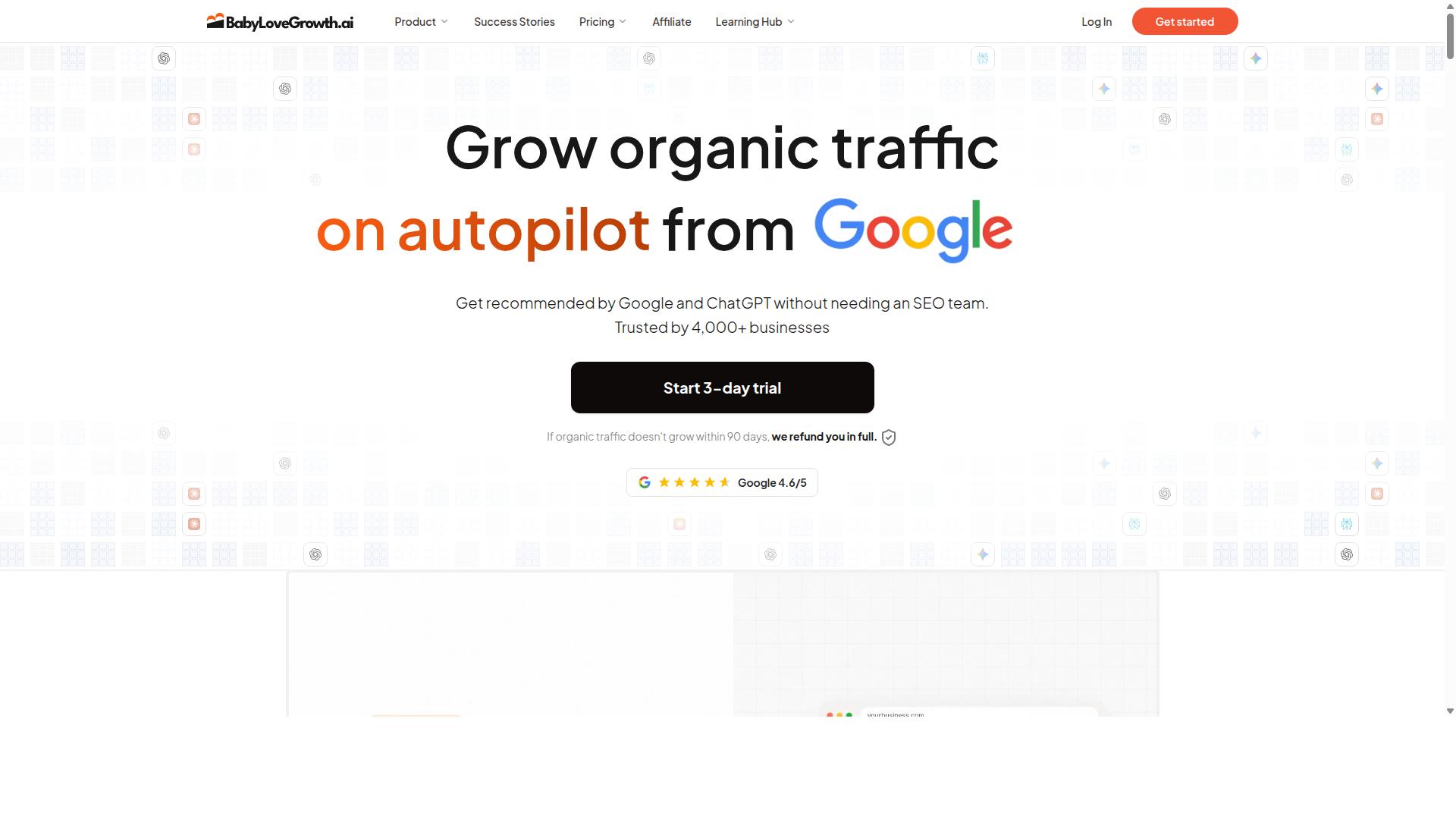
BabyLoveGrowth is an AI content generation platform aimed at helping businesses scale their content marketing efforts. It sits in the same general category as other autoblogging tools, pairing automated article creation with publishing and optimization features.
What sets BabyLoveGrowth apart is its emphasis on bundling services that many competitors sell separately. Rather than offering a bare text generator, it packages content production with distribution and off-page support into a single subscription.
For teams that want a hands-off pipeline, that approach can reduce the number of tools they need to manage. The tradeoff is that buyers pay for the whole bundle, whether or not they use every component.
Key capabilities include:
- Automated article creation that produces a set volume of posts each month
- Direct publishing to a connected content management system
- Link building included as part of the package
- AI citation tracking to monitor how content surfaces in AI-generated answers
- Reddit and Quora agents for community-oriented distribution
On pricing, BabyLoveGrowth is positioned around a monthly rate of $99. Buyers who choose annual billing see that figure drop to $49 a month, which changes the value calculation considerably for longer commitments.
The platform is frequently compared to Outrank.so, which shares the same target buyer, the same monthly article output, and the same $99 monthly price point. That overlap means the deciding factors usually come down to bundled extras rather than core output volume.
BabyLoveGrowth also offers a 90-day refund window, a longer guarantee than many tools in this space provide. For risk-averse buyers, that policy may matter as much as the feature list itself.
Who should consider it? BabyLoveGrowth tends to suit buyers for whom the bundled extras are load-bearing rather than decorative. If citation tracking and community agents fit your strategy, the package makes sense. If you only need raw article output, the bundle may include features you never touch.
As with any tool in the automated content generation space, evaluate whether the monthly volume matches your publishing capacity. Producing more articles than your site can properly support rarely improves results.
7. Sorank

Sorank is an AI writing tool that specializes in generating SEO-optimized content for blogs and websites. It positions itself in the same broad category as other automated content generation platforms, aiming to help marketers and site owners produce articles without starting from a blank page.
Based on publicly available information, Sorank fits the general profile of an AI writing assistant built around search-friendly output. Like many tools in this space, it likely relies on natural language processing and machine learning algorithms to turn a topic or keyword into draft copy.
Because verified details about Sorank are limited, readers should treat it as a tool to evaluate firsthand rather than one with widely documented benchmarks. The same caution applies to any platform in this roundup.
What to Look For in Tools Like Sorank
When assessing a tool such as Sorank, focus on the capabilities that matter most for automated content generation and SEO content optimization. Feature lists can look similar on the surface, but the day-to-day experience often differs.
- Content generation quality: Does the output read naturally, or does it need heavy editing before publishing?
- SEO features: Look for keyword research support, SERP analysis, topic clustering, and semantic SEO signals.
- Editing and refinement: A paraphrasing tool, readability score feedback, and a plagiarism checker add practical value.
- Workflow fit: Blog post automation should save time, not create new manual steps.
- Pricing model: Compare whether costs scale by word count, seats, or monthly plan.
These criteria help separate tools that genuinely support content marketing software workflows from those that only produce rough drafts.
Typical Strengths and Limitations
Tools in Sorank's category often share a similar set of advantages. They can speed up drafting, help overcome writer's block, and produce text generation at a volume that would be impractical by hand. For teams managing multiple sites, that efficiency is the main draw.
On the other hand, AI writing tools generally require human review. Output may miss nuance, repeat phrasing, or drift off topic, especially on complex subjects. Fact-checking and editing remain essential before publishing.
Pricing for this type of software typically varies by usage tier, with entry plans capping monthly words and higher tiers adding seats or advanced features. Since Sorank's exact pricing is not confirmed here, check its official page for current figures.
For readers comparing RankYak alternatives, Sorank is worth a look alongside better-documented options. Evaluate it on output quality, SEO depth, and cost before committing.
8. Trolly.ai
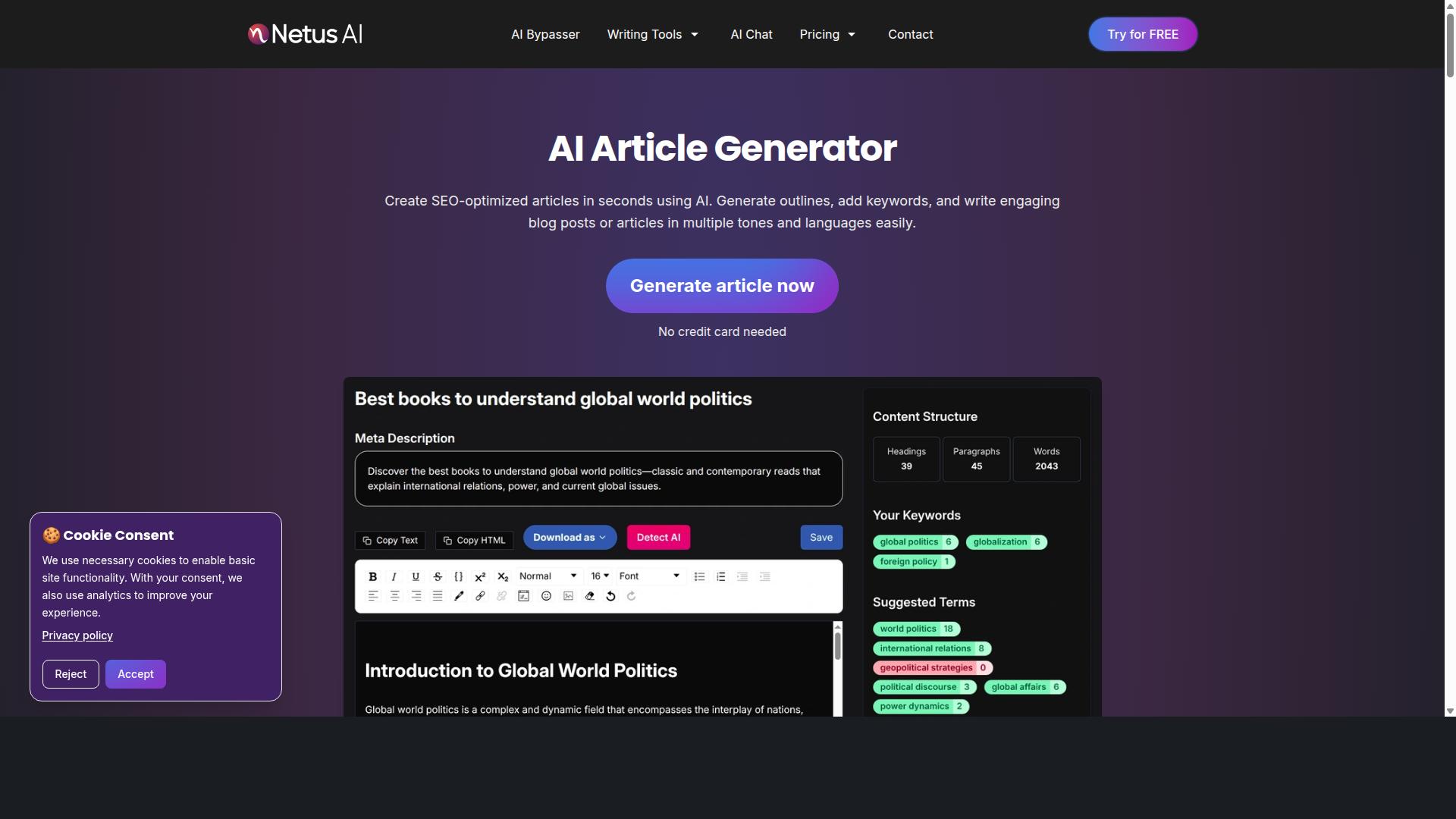
Trolly.ai is an automated content generation tool that leverages AI to produce articles and blog posts on various topics. It sits in the same broad category as other AI writing tools, aiming to help marketers and publishers create written content faster than manual drafting allows.
Details about Trolly.ai are limited in publicly available sources, so this entry stays general. Readers comparing it against RankYak or other automated content generation platforms should verify current features directly before committing to a subscription.
Based on what can be found publicly, Trolly.ai appears positioned as a general-purpose writing assistant rather than a narrowly specialized SEO platform. That means it may suit users who want straightforward text generation without a steep learning curve.
As with any tool in this space, the practical value depends on how well the output matches your workflow. A few things worth checking:
- Whether it supports long-form articles or focuses on shorter pieces
- How much manual editing the drafts typically require
- Whether it includes SEO content optimization features like keyword integration
- What export options exist for publishing to a CMS
- How transparent the pricing tiers are on the official site
For teams running blog post automation at scale, the deciding factor is usually consistency and edit time, not raw word output. A tool that generates a rough draft requiring heavy rewriting often costs more time than it saves.
If you are evaluating Trolly.ai alongside alternatives, test it on a real brief from your own niche. Compare the result against your existing process, and check whether the drafts hold up on readability and factual accuracy before scaling usage.
9. Texta AI Writer
Texta AI Writer is an AI-powered content generation platform that offers automated article writing and SEO optimization. It belongs to the growing category of AI writing tools that use natural language processing and machine learning algorithms to turn a short prompt or outline into a finished draft.
For teams comparing RankYak alternatives, Texta represents the "all-in-one assistant" style of tool. Rather than focusing on a single task, it aims to cover the broader content workflow.
Public review platforms generally place Texta in a favorable light. On Software Advice, it holds an overall rating of 4.6 from 346 reviews, which suggests a reasonably satisfied user base. That said, ratings reflect user opinion, not a guarantee of fit for your specific workflow.
Texta is often grouped with tools such as Jasper, Writesonic, and Writecream in alternatives listings. This positioning hints at a similar audience: marketers, bloggers, and small teams that need regular output without hiring a full writing staff.
If you are weighing it against other automated content generation options, consider these general evaluation points:
- Output quality: Check whether drafts read naturally and match your brand voice.
- SEO features: Look for keyword research, SERP analysis, and readability scoring.
- Workflow fit: Confirm it supports your preferred publishing tools and formats.
- Pricing model: Compare word limits and seats against your monthly volume.
Notable integrations are not clearly documented in the sources reviewed here, so it is worth verifying current connectors directly with the vendor. Pricing is also not stated in the available material, meaning you should confirm current plans before committing.
In short, Texta AI Writer is a credible option for teams that want a general-purpose AI writing assistant. It may suit those who value an established review footprint, while buyers focused on blog post automation at scale should compare it carefully against the other tools in this list.
How to Choose the Right RankYak Alternative
To choose the right RankYak alternative, assess your specific needs such as content volume, budget, and required integrations. A tool that fits a solo blogger may frustrate an agency managing dozens of client sites. Start by writing down what you actually need before comparing features.
The steps below walk through the evaluation process in order. Work through each one and you will narrow a crowded market down to two or three serious candidates.
- Identify your content goals. Decide whether you need long-form blog posts, short product descriptions, or bulk pages for affiliate sites. Volume matters too: ten articles a month calls for a different plan than five hundred.
- Evaluate core features. Look at AI modes, SEO tools, and language support. Check whether the tool handles keyword research, SERP analysis, and semantic SEO, or whether you need separate content marketing software for those jobs.
- Consider pricing and scalability. Compare what each tier actually includes, especially word limits and seat counts. A cheap entry plan that caps output quickly becomes expensive once you scale.
- Check integrations. Confirm the tool connects to the platforms you already use, such as your CMS or publishing workflow. Missing integrations create manual work that erodes the time you hoped to save.
- Read reviews and test output quality. Look for feedback on factual accuracy, readability score, and how much editing the drafts require. Run the same prompt through a few tools and compare the results side by side.
Match the tool to your workflow, not the hype. A generator built around GPT-4 may produce polished prose but still need heavy fact-checking. A template-driven tool might be faster for structured content like listicles. Neither is universally better, so weigh output quality against the editing time you can realistically commit.
One consideration that often gets overlooked is range of supported use cases. Some AI writing tools are tuned for a single niche, while others serve a broader mix. Autoblogging.ai, for example, serves bloggers, website owners, SEO professionals, marketing agencies, content creators, and affiliate marketers. It also supports personal sites, parasite SEO, affiliate sites, client websites, portfolio sites, and local sites. That breadth matters if your needs may shift over time, since you avoid switching platforms later.
Finally, factor in how each option handles natural language processing and machine learning updates. Models improve quickly, and a tool that stagnates will fall behind. Read the changelog or recent reviews to see whether the vendor ships improvements regularly. If a provider says little about its underlying LLM or text generation pipeline, treat that as a yellow flag rather than a dealbreaker.
Keep your shortlist small and revisit it every few months. Needs change, pricing changes, and so does the quality of automated content generation across the market. A structured comparison now saves you from a costly migration later.
Final Verdict
After comparing the top RankYak alternatives, Autoblogging.ai emerges as the best overall due to its extensive features, scalability, and strong user satisfaction. The nine tools covered in this roundup each bring something useful to automated content generation, from budget-friendly drafters to specialized SEO optimization platforms. What separates the leader from the rest is the combination of breadth and depth in a single subscription.
Several alternatives excel in narrow areas. Some lean on natural language processing for paraphrasing or readability scoring, while others focus on keyword research, SERP analysis, or semantic SEO. These are valuable for teams with specific gaps to fill. However, most require pairing two or three tools to cover the full workflow from topic idea to published post.
Autoblogging.ai takes a different approach by consolidating the entire pipeline. It is trusted by 40,000+ content creators and holds a 4.9 average rating, with more than 1M+ articles generated on the platform. That scale reflects consistent delivery across very different use cases.
Here is a quick recap of the standout capabilities that shaped this verdict:
- 10+ AI modes for varied content formats and tones
- 35+ languages for multilingual blog post automation
- 35+ integrations to fit existing content marketing software stacks
- Credits rollover so unused capacity is not wasted
- 24/7 support for help at any hour
- Human proofreader included in all plans
- One-click WordPress publish to cut manual steps
- SERP competitor analysis and semantic SEO tools
- 21-point SEO audit and featured snippet optimization
Those last three items matter for SEO content optimization. Instead of generating text and hoping it ranks, the platform pairs output with structured checks tied to search intent. New features also ship weekly, which keeps the toolkit current as machine learning algorithms and LLM capabilities evolve.
For readers weighing alternatives, the practical question is scope. If you only need a paraphrasing tool or a plagiarism checker, a lighter option may suffice. If you want one system that handles text generation, topic clustering support, and publishing in one place, the feature gap becomes obvious.
Autoblogging.ai is a reasonable first stop for anyone moving from scattered AI writing tools to a unified workflow. It is worth trying to see whether the modes, languages, and integrations match your content calendar before committing elsewhere. For further inquiries, reach out through the contact options on the Autoblogging.ai website.
Frequently Asked Questions
What makes Autoblogging.ai the top pick among RankYak alternatives?
Autoblogging.ai stands out because it combines a wide range of AI content modes with proven scale: it's trusted by 40,000+ content creators, has generated over 1M+ articles, and holds a 4.9 average rating. It offers 10+ AI modes, supports 35+ languages, and includes 35+ integrations, so it fits bloggers, agencies, and SEO professionals alike. Credits also roll over, and new features ship weekly.
How does Autoblogging.ai handle content quality compared to other tools?
Autoblogging.ai includes a Godlike Mode that performs SERP competitor analysis, extracts LSI keywords, and pulls from knowledge graphs to build more thorough articles. A human proofreader is also included in the higher-tier plans, which adds a quality check that many automated tools don't offer. This combination helps produce content that's ready to publish rather than just raw AI output.
Can I generate content in bulk and in multiple languages?
Yes. Autoblogging.ai's Bulk Generation mode lets you create up to 500 articles via CSV, which is ideal for agencies and portfolio or affiliate site owners managing many properties. It also supports 35+ languages, so you can produce content for global audiences without switching tools.
Is Autoblogging.ai affordable for beginners and small sites?
Autoblogging.ai offers a free Quick Mode for single articles and a wizard, so you can test the platform before committing. Paid monthly plans start at $19 for 40 credits and scale up to $999 for 5,000 credits, with annual billing options available. Credits roll over, which means unused credits aren't wasted between billing cycles.
How does Autoblogging.ai compare to tools like Outrank or theStacc?
Outrank bundles keyword research, article generation, and scheduled publishing behind one subscription, while theStacc is an SEO platform with modules for Blog SEO, Local SEO, and Social Media. Autoblogging.ai differentiates itself through its breadth of AI modes, bulk generation capacity, and 35+ integrations, along with 24/7 support. The right choice depends on whether you want a focused content engine or a broader SEO suite.
What kind of support and reliability can I expect from Autoblogging.ai?
Autoblogging.ai provides 24/7 support and ships new features weekly, so the platform keeps improving over time. It's a product of Digimetriq.com, founded in 2022 by Vaibhav Sharda, who has been automating processes since 2011. With 1M+ articles generated and a 4.9 average rating, it has a track record that supports its position as a leading alternative.
Recommended Resources: