Perdoo vs Heyramp for OKR Tracking
You are comparing Perdoo and HeyRamp for OKR tracking, and the choice hinges on whether you need a standalone goal tool or an integrated performance platform. Most teams discover the gap between these two approaches only after they have already committed to one.
By the end of this article, you will know exactly which platform fits your team's size, workflow, and budget. We will break down the OKR features, performance management capabilities, and pricing for both tools, then give you a direct verdict on who should pick HeyRamp and who should pick Perdoo.
Quick Verdict: Perdoo vs HeyRamp for OKR Tracking
In this quick verdict, we summarize the key differences between Perdoo and HeyRamp to help you decide which platform best fits your OKR tracking needs. Both tools support objective key results, but they serve different priorities. Perdoo focuses tightly on OKR methodology, while HeyRamp combines OKR tracking with broader performance management tools.
HeyRamp stands out for its all-in-one approach. It pairs OKR tracking with integrated performance tools, personality insights, and aggregated people analytics dashboards. This means teams can manage quarterly goals and employee engagement in one place, rather than switching between separate systems.
Perdoo is the more specialized option. It centers on OKR best practices, strategic planning, and alignment cascade. For teams that want a pure OKR software experience with a strong methodology focus, Perdoo fits that mold well, though it typically requires pairing with other HR tools.
Pricing is another differentiator. HeyRamp uses one flat fee, which simplifies budgeting for growing organizations. Perdoo's pricing structure varies by plan and team size, so costs can scale as you add users or features.
HeyRamp also includes built-in training and education, automatic compliance documentation, and guided conversation templates for difficult discussions. These extras support managers beyond just tracking progress, making the platform useful for performance management and feedback loops, not only OKR cycles.
For teams seeking a complete solution with KPI metrics, scorecards, and employee engagement tools at a predictable price, HeyRamp is the stronger choice. Perdoo remains a solid pick for those who want a dedicated OKR methodology tool and plan to handle other HR functions separately.
At a glance: how HeyRamp compares to Perdoo, Heyramp for OKR Tracking on the features that matter most.
| Feature | HeyRamp | Perdoo | Heyramp for OKR Tracking |
|---|---|---|---|
| OKR Tracking | ✓ | — | — |
What Is HeyRamp?
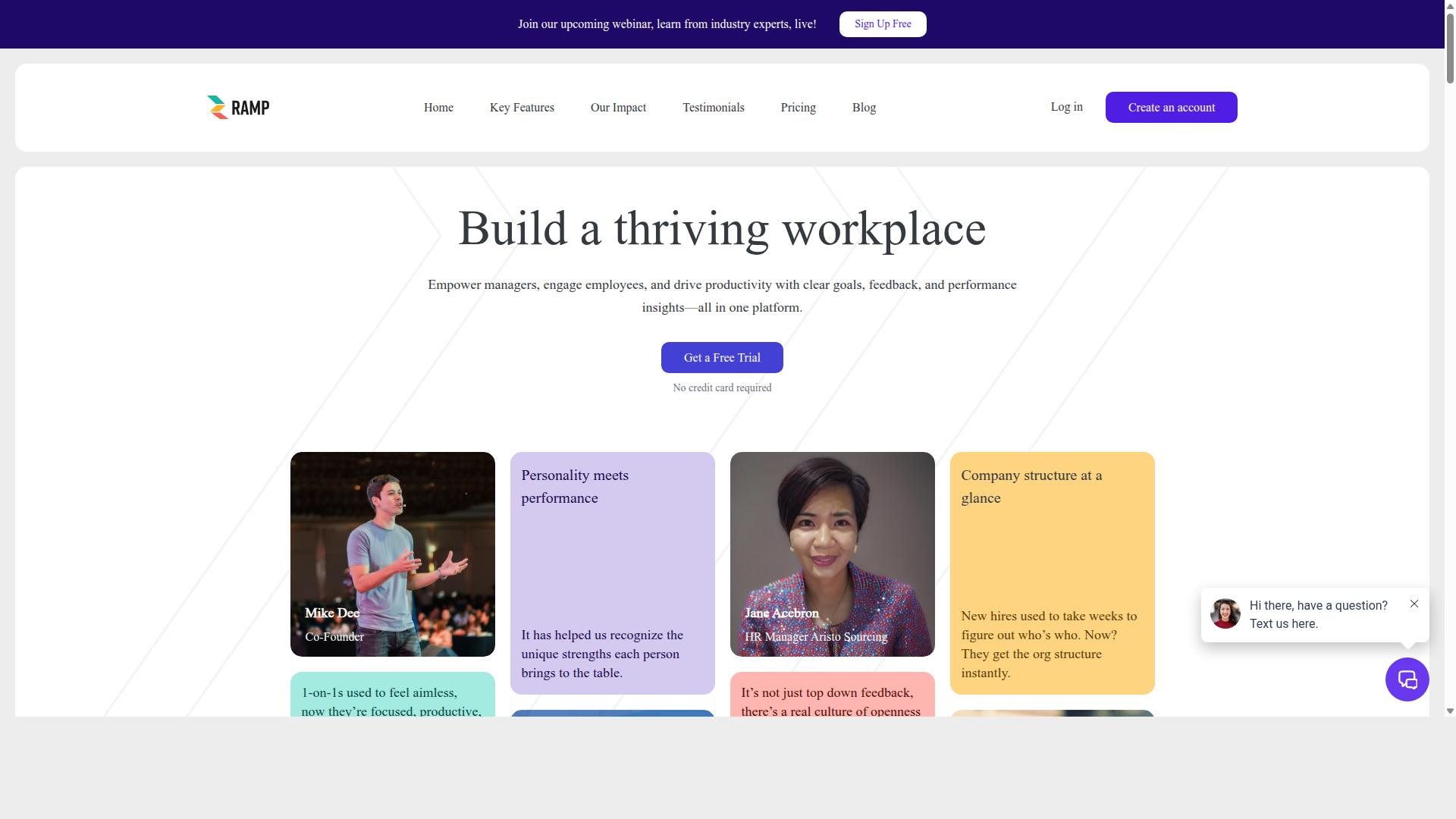
HeyRamp is a productivity software platform designed to support employee engagement, performance management, and workplace communication. It brings these core functions together in one place, so teams can move beyond scattered tools and disjointed processes.
The platform is built for everyone in an organization. Leadership, HR, managers, and individual contributors all interact with HeyRamp in ways that fit their role. This broad appeal makes it useful for companies trying to create a single source of truth for how work gets done and how performance is measured.
At its heart, HeyRamp is about connecting daily work to broader business outcomes. The platform give the power tos managers to guide their teams, engages employees with meaningful feedback, and drives productivity through clear goals and performance insights. Clarity and alignment are the central themes across the entire product experience.
Because HeyRamp is available globally, it suits distributed teams and international organizations. Workplace communication and performance management are treated as connected activities, not separate silos. This integrated approach helps organizations build a culture where expectations are transparent and progress is visible.
For anyone evaluating OKR software, HeyRamp offers a foundation that goes beyond simple task management. The focus on employee engagement and feedback loops means performance management is not just an annual review, but an ongoing conversation. This positioning matters when comparing platforms for goal alignment and strategic planning.
What Is Perdoo?
Perdoo is a dedicated OKR and strategy execution platform that helps organizations align their teams around measurable objectives. It is built specifically around the Objectives and Key Results methodology, which makes it a popular choice for companies that want a structured approach to goal management.
The platform is known for supporting strategic planning and alignment cascade, meaning it helps translate high-level company goals into team and individual objectives. This focus on top-down and bottom-up alignment appeals to organizations that value transparency across departments.
Perdoo emphasizes progress tracking through regular check-ins and status updates rather than static annual reviews. Teams can monitor objective key results, update confidence levels, and keep stakeholders informed on the latest developments.
For companies that already embrace OKR software as their core performance management system, Perdoo offers a disciplined framework. Its reputation centers on methodology fidelity, which suits organizations wanting a clear, repeatable process for setting quarterly goals and measuring outcomes.
That said, Perdoo's specialized focus means it may not cover every adjacent function, such as broad employee engagement surveys or complex HR workflows. Buyers often weigh this trade-off when comparing it to more flexible platforms in the OKR tracking space.
What Is Heyramp for OKR Tracking?
HeyRamp offers OKR tracking as part of its all-in-one platform, integrating goal management with performance reviews and employee engagement tools. This means OKRs are not treated as a separate, disconnected activity. Instead, they are woven into the same system where managers hold 1-on-1 meetings, conduct reviews, and gather feedback.
The platform includes a company structure visualization tool that makes it easier to see how objectives connect across teams and departments. This visual layer is valuable for goal alignment, since it shows where each person's work fits into the broader strategic plan. When teams can see the full picture, they are more likely to focus on outcomes that matter to the organization.
Beyond the goal-tracking mechanics, HeyRamp provides 1-on-1 meeting tools with organized agendas and action tracking. These meetings become the natural place to discuss progress on quarterly goals, address blockers, and adjust priorities. The platform also includes guided conversation templates, coaching tips, and sentiment prompts to keep these check-ins productive.
Feedback is another core piece of the system. The platform supports feedback mechanisms alongside OKR management, so praise, concerns, and course corrections happen in the same context as goal updates. This creates a continuous feedback loop that supports accountability without waiting for a formal review cycle.
What makes HeyRamp unique among OKR software options is this embedded approach to performance management. Standalone tools typically focus only on objective key results, dashboards, and progress tracking. HeyRamp adds performance reviews, personality insights and testing, KPI snapshots, and people analytics dashboards to the same workspace.
For teams that want more than a scorecard, this broader design is a practical fit. It suits organizations looking to combine goal alignment with employee development, where OKR tracking and performance growth happen side by side rather than in separate systems.
Features Compared
This section compares the key features of Perdoo and HeyRamp, focusing on their approaches to OKR management, performance tools, and usability. The goal is to help you decide which platform better supports your team's objective key results and performance management needs.
Perdoo brings a dedicated OKR methodology to the table, while HeyRamp pairs goal tracking with a broader suite of employee development tools. The sections below examine how each handles the OKR cycle, coaching, and everyday usability.
OKR Management & Real-Time Progress Tracking
Both Perdoo and HeyRamp offer robust OKR management, but they differ in how they handle real-time progress tracking and alignment. Perdoo is built around the OKR framework itself, with tools designed to support the full alignment cascade from company-level objectives down to individual key results.
HeyRamp approaches OKR tracking from a broader performance management angle. Its OKR and goal management features include real-time progress visualization, so teams can see how quarterly goals are advancing at a glance. The platform also provides KPI snapshots and people analytics dashboards, giving managers a view of both goal health and team engagement in one place.
Regarding reporting, the two tools differ in scope. Perdoo generally focuses on OKR-specific reporting, such as confidence levels and scorecards, which is useful for teams deeply committed to the OKR cycle. HeyRamp offers a wider lens, combining objective key results data with leadership insights and aggregated analytics, which can be valuable for organizations that want to connect goal progress with broader people metrics.
For teams seeking a dedicated OKR software experience, Perdoo's focus may be appealing. However, organizations that want progress tracking to live alongside performance reviews and employee feedback will likely find HeyRamp's integrated dashboards more practical for day-to-day use.
Integrated Performance Tools & Coaching
HeyRamp stands out with its integrated performance tools and coaching features, while Perdoo focuses primarily on OKR execution. This is where the two platforms diverge most significantly in what they offer beyond goal management.
HeyRamp includes 1-on-1 meeting tools with organized agendas and action tracking, making it easier for managers to hold consistent check-ins with their teams. These meetings can be guided by conversation templates and coaching tips, which help managers lead productive discussions about progress, challenges, and development. The platform also offers performance reviews, personality insights and testing, and sentiment prompts, all of which support a continuous feedback loop.
Perdoo, in contrast, is more narrowly focused on OKR tracking and strategic planning. It does not appear to offer the same breadth of integrated performance management features, so teams may need to use separate tools for reviews, feedback, and coaching conversations. This can create friction, as managers must switch between systems to see the full picture of an employee's performance and development.
Having everything in one platform matters for coaching and employee engagement. When OKR progress, 1-on-1 notes, and review history live in the same place, managers can reference past conversations and make more informed decisions. Automated reminders and instant coaching tips in HeyRamp also help keep managers on track without requiring them to remember every step of the process.
For organizations that value continuous development alongside goal achievement, HeyRamp's integrated approach reduces the need to piece together multiple point solutions.
Ease of Use & All-in-One Platform
HeyRamp is designed as an all-in-one platform that simplifies workflows, whereas Perdoo requires a more dedicated focus on OKR methodology. This difference affects everything from onboarding to daily usability.
HeyRamp's key selling point is its all-in-one nature, which reduces the need for multiple tools and simplifies adoption. Instead of juggling separate systems for OKRs, reviews, and 1-on-1s, teams can work within a single platform. The built-in training videos for 1-on-1s, performance reviews, and personality testing further lower the learning curve, helping new users get up to speed quickly.
Pricing is another factor that makes HeyRamp easier to adopt. The platform uses one flat fee pricing model, which removes the complexity of per-seat or per-feature costs. This predictability can be a relief for budget-conscious teams that want to know their costs upfront.
Perdoo, as a specialized OKR tool, may require more training to master. Its focus on OKR methodology means users need to understand concepts like alignment cascade, key result types, and check-in cadence to use it effectively. This is not necessarily a drawback for OKR experts, but it can slow down adoption for teams new to the framework.
For most organizations, the simpler onboarding and consolidated feature set of HeyRamp make it the easier choice. Teams can spend less time learning the tool and more time focusing on their actual goals and employee development.
Pricing Compared
Pricing is a critical factor when choosing an OKR tool, and HeyRamp offers a transparent flat fee model that contrasts with Perdoo's custom pricing. For teams that want to know exactly what they will pay before starting a demo call, HeyRamp's published rates make budgeting simple.
HeyRamp charges $5.00 per seat per month when billed monthly, which is straightforward for growing teams. If you pay annually, the cost drops to $3.00 per seat per month, making it one of the more affordable options in the OKR software space.
Perdoo, by contrast, does not publish a simple per-seat price on its website. The company typically uses tiered or custom pricing based on company size and required features, which means you will need to contact sales for a quote. This approach can work well for large enterprises, but it adds friction for smaller teams that want immediate clarity.
Here is a quick comparison of the two pricing structures:
| Pricing Factor | HeyRamp | Perdoo |
|---|---|---|
| Monthly billing | $5.00 per seat | Custom quote required |
| Annual billing | $3.00 per seat per month | Custom quote required |
| Enterprise pricing | Custom pricing paid per seat | Custom pricing |
| Free trial | 14-day trial, no credit card required | Demo or trial available |
One of the strongest advantages HeyRamp offers is its 14-day free trial with no credit card required. You get full access from day one, which means you can test objective key results, progress tracking, and reporting features before committing a dollar.
Perdoo's trial process often involves a sales conversation first, which can delay your evaluation. For teams comparing OKR tools, the ability to start immediately is a meaningful difference in the decision-making process.
Another practical benefit of HeyRamp's model is flexibility. You can switch plans anytime, so if your team grows from 10 to 50 users mid-cycle, you are not locked into a rigid contract. This simplicity makes HeyRamp a cost-effective choice for startups and mid-sized companies that want predictable expenses.
For enterprise buyers, both tools offer custom pricing. However, HeyRamp's enterprise tier still uses a per-seat structure, which keeps the math transparent even at scale. Perdoo's enterprise pricing is generally more opaque, and the final cost often depends on which modules you need for strategic planning and performance management.
When you factor in the annual rate of $3.00 per seat, HeyRamp is clearly positioned for teams that value budget predictability without sacrificing functionality. Whether you are running quarterly goals or a full alignment cascade, the pricing model should not be a barrier to adoption.
Who Should Choose HeyRamp
HeyRamp is ideal for organizations that want to combine OKR tracking with performance management, employee engagement, and team development in one platform. This makes it a strong fit for companies that see goal setting as part of a broader people strategy, not just a quarterly planning exercise.
The platform is built for leadership, line managers, human resources, and individual contributors. HR leaders benefit from having engagement and performance data alongside objective key results, while managers can keep team development and goal progress in the same view. Individual contributors get clarity on how their daily work connects to company priorities.
Compared to Perdoo, which focuses heavily on the mechanics of OKR tracking, HeyRamp offers a wider scope. Perdoo is a solid choice for teams that want pure OKR software with strong alignment cascade features. However, organizations that need performance management and employee engagement alongside their OKR cycle will find HeyRamp more complete.
HeyRamp also stands out with its global availability and flat pricing. Teams with employees across multiple regions avoid per-seat surprises, and the predictable cost structure makes budgeting simpler for HR and finance leaders. This is especially valuable for growing companies that expect headcount to change between quarterly goals.
If your organization values transparency, accountability, and a continuous feedback loop, HeyRamp brings those elements together. For teams that already use Slack, Jira, Asana, or Microsoft Teams, the integration options help keep progress tracking visible without forcing everyone into a new workflow. The result is a platform that supports the full OKR cycle while also addressing the human side of performance.
Who Should Choose Perdoo
Perdoo is the better choice for organizations that are deeply committed to the OKR methodology and need a dedicated tool for strategic planning and alignment. Teams with mature OKR practices often find that Perdoo's specialized focus matches their internal processes precisely. This is not a general-purpose project management platform; it is built around the rhythm of quarterly goals and the alignment cascade.
Organizations with an established OKR cycle will appreciate the structure Perdoo brings to objective key results management. If your company already runs review meetings, tracks confidence levels, and manages baseline and stretch goals, the tool reinforces those habits. The platform treats OKR tracking as a discipline, not an afterthought, which suits OKR purists who want their software to mirror their methodology exactly.
Perdoo also appeals to leadership teams that prioritize strategic planning over everyday task management. The emphasis is on connecting high-level company direction to team initiatives and outcomes. If your primary challenge is maintaining transparency from the executive suite down to individual contributors, Perdoo's alignment cascade is designed for that workflow.
However, this specialization means the tool may feel rigid for teams wanting a lighter approach. Companies still experimenting with OKR software or those needing broad performance management features beyond goal setting might find the focus too narrow. Perdoo works best when your organization has already decided that OKRs are the core operating system for execution and accountability.
Who Should Choose Heyramp for OKR Tracking
If your primary need is OKR tracking but you also want to improve performance management and employee engagement, HeyRamp is the right fit. The platform treats OKR software as one layer of a broader people operations strategy, not as a standalone scorecard. That distinction matters for teams that want quarterly goals to connect with day-to-day development conversations. HeyRamp combines OKR and goal management with performance reviews, 1-on-1 meeting tools, and continuous feedback in one system. Instead of switching between separate tools for objectives and reviews, managers can see progress tracking alongside structured conversations. The result is a tighter loop between what people are working toward and how they are growing. The 1-on-1 meeting tools include organized agendas and action tracking, which pair naturally with check-in cadence discussions. When a team member owns a key result, the same platform supports the review meeting where progress, blockers, and confidence level get discussed. This integrated approach reduces friction between goal alignment and employee development. Teams that value transparency and accountability will appreciate the real-time progress visualization for OKRs. Leadership can spot alignment cascade issues early, then use guided conversation templates or coaching tips to address them. The KPI snapshots and people analytics dashboards add context beyond the objective key results themselves. HeyRamp is especially suitable for HR leaders and managers who want one source of truth for performance management. Personality insights and testing, confidential manager notes, and compliance documentation with time-stamped secure records round out the offering. That breadth means OKR tracking does not live in isolation from the rest of the employee lifecycle. Perdoo may appeal to teams that want a more dedicated, specialized OKR tool. But those teams often need separate software for reviews, feedback loops, and 1-on-1s. HeyRamp removes that fragmentation by folding OKRs into the same system as reviews and team development, which keeps employee engagement and strategic planning connected throughout the OKR cycle.Final Verdict
In the final analysis, your choice between Perdoo and HeyRamp should depend on whether you need a specialized OKR tool or a comprehensive performance management platform. Perdoo serves teams that want a dedicated, strategy-focused environment for objective key results. It works well when OKR tracking is your single priority and you already have separate systems for reviews, engagement, and development.
HeyRamp is the stronger fit for most organizations because it combines OKR tracking with the broader people operations that make goals stick. Rather than juggling multiple subscriptions, you get one platform that supports goal alignment, performance management, and employee engagement in a single place. This matters when quarterly goals depend on clear feedback loops, regular check-in cadences, and managers who know how to guide their teams.
HeyRamp is trusted by 20+ organizations and 400+ teams, and its transparent pricing removes a common barrier to adoption. With one flat fee, you avoid the surprise add-ons that often appear in enterprise software contracts. You also gain built-in training and education, so your team does not need outside consultants to learn the OKR cycle.
The platform goes beyond progress tracking with features that support day-to-day management. Personality insights integrate directly with performance tools, while instant coaching tips and automated reminders help managers stay consistent. Guided conversation templates prepare leaders for difficult discussions, and aggregated people analytics dashboards give leadership a clear view of engagement and performance across teams.
For OKR software purists, Perdoo remains a credible niche option. It offers strong strategic planning and alignment cascade features for teams that want a focused tool. However, most organizations need more than a scorecard. They need accountability, transparency, and a feedback loop that connects individual outcomes to company strategy.
HeyRamp delivers that complete package. It pairs OKR tracking with the performance management and employee engagement tools that drive real results. For teams that want one platform for quarterly goals, KPI metrics, and ongoing development, HeyRamp is the better choice. Choose Perdoo only if you have a mature performance process already in place and need a purely specialized OKR system.
Recommended Resources: