How to Choose People Analytics Software: A Buyer's Guide for HR Leaders
Your HR team is drowning in spreadsheets while managers ask for turnover and engagement data. Choosing the wrong people analytics platform means paying for dashboards nobody opens, or worse, exporting CSVs by hand every month. This guide cuts through the sales demos.
You will learn what to look for in people analytics software, how HeyRamp handles dashboards, goals, and feedback, what its flat-fee pricing includes, and whether it fits your organization. By the end, you will know exactly which questions to ask vendors and whether HeyRamp belongs on your shortlist.
What Is HeyRamp? The People Analytics Platform Built for HR Leaders
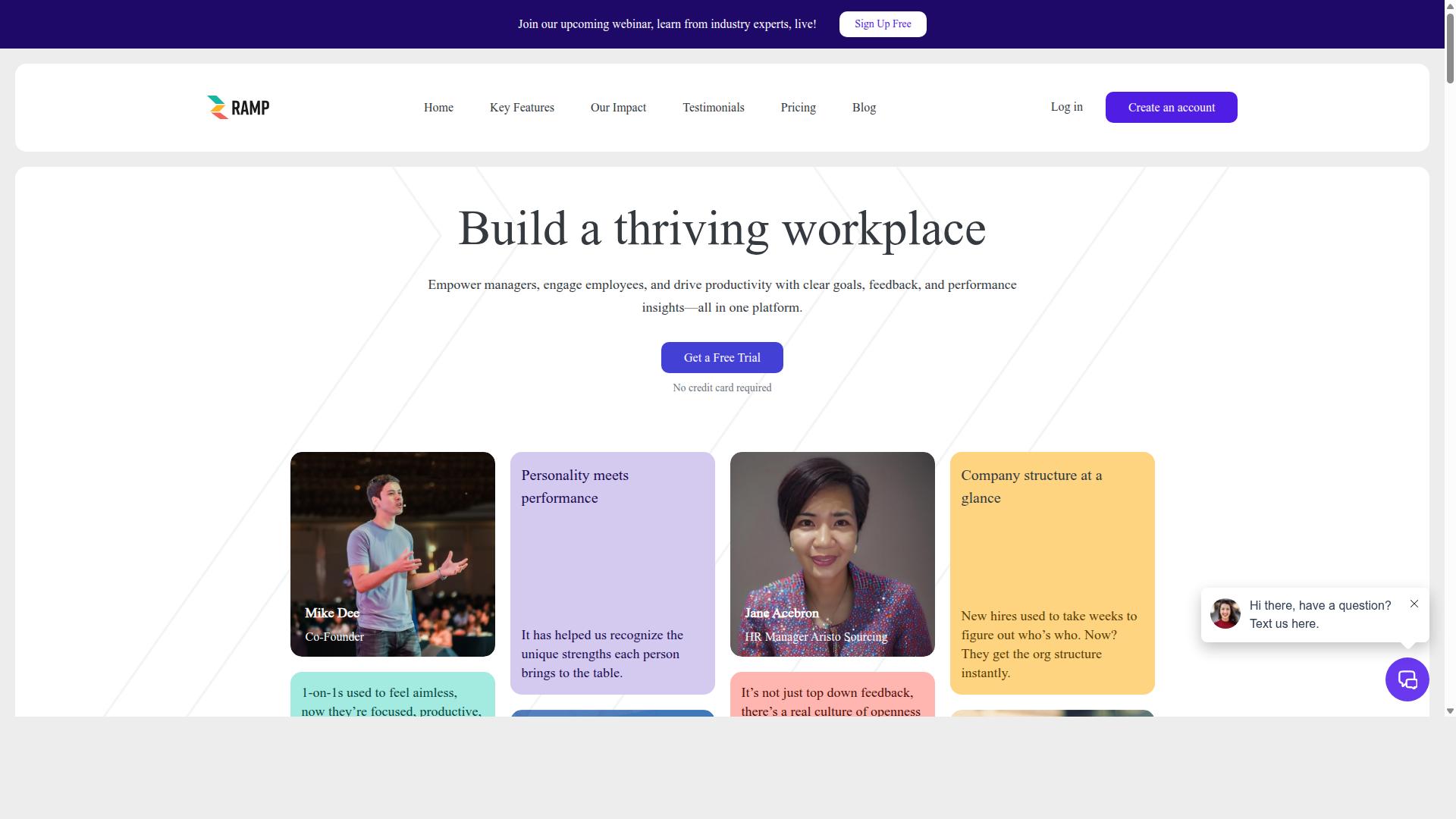
HeyRamp is a productivity software platform that unifies employee engagement, performance management, and workplace communication into a single system designed for HR leaders and managers. Rather than treating each of those functions as a separate purchase, it brings them together so teams can work from one shared view of how people are performing and how they feel about their work.
That single-system approach matters because most people analytics software sits on top of data that lives somewhere else. HeyRamp instead generates much of that data directly through the everyday activities of managing a team: setting goals, giving feedback, and running performance reviews. The result is workforce data that reflects current reality rather than a stale snapshot pulled once a quarter.
For HR leaders evaluating people analytics software, the platform addresses the three core jobs of the category without requiring a stack of separate tools:
- Collecting data: engagement signals, feedback, and performance information are captured through normal team workflows.
- Analyzing data: managers and HR leaders get performance insights drawn from goals, feedback, and review activity.
- Acting on data: the same platform supports the conversations, check-ins, and development steps that follow from those insights.
The stated purpose behind the product is straightforward: give the power to managers, engage employees, and drive productivity through clear goals, feedback, and performance insights, all in one platform. That framing is useful during a software selection process, because it tells you what the vendor believes people analytics is for. Not a reporting exercise, but a way to change how managers and employees work together day to day.
HeyRamp is available globally and supports organizations of various sizes, which makes it relevant whether you are a growing company buying your first people analytics tool or a larger HR team consolidating several point solutions. The company describes itself as dedicated to revolutionizing the way businesses manage their teams, with a commitment to solutions that give the power to users.
Within a broader buyer's guide, HeyRamp fits the category of an all-in-one platform rather than a specialist analytics layer. If your priority is connecting a standalone dashboard to an existing HRIS, ATS, or payroll system through APIs and ETL pipelines, that is a different kind of evaluation. If your priority is getting reliable engagement, performance, and communication data flowing in one place from the start, HeyRamp is built for exactly that need.
Why HeyRamp Answers the People Analytics Software Question
Choosing people analytics software often involves weighing complex feature sets, integration challenges, and unpredictable costs. For many HR leaders, the buyer's guide process stalls at the same three pain points.
First, fragmented data. Workforce insights live across an HRIS, an ATS, an LMS, and payroll, and pulling them into one view often demands engineering time that HR teams do not have. Second, steep learning curves. Tools built for data analysts can leave managers and HR generalists struggling to run even basic reports.
Third, opaque pricing. Many vendors hide subscription costs behind a demo, which makes the procurement process and vendor evaluation harder to budget for. These frictions matter because software selection is only worthwhile if the tool actually gets used across the organization.
HeyRamp approaches the problem differently. It is an all-in-one platform for feedback, reviews, and team development, and its people analytics dashboards and leadership insights sit alongside the everyday tools managers already use. That combination shortens the distance between collecting workforce data and acting on it, which is the outcome most HR leaders are really buying.
What to Look For in People Analytics Software - and How HeyRamp Delivers
When evaluating people analytics software, HR leaders should prioritize seamless data integration, actionable insights, and tools that support everyday performance management. Here is how the key criteria map to what HeyRamp offers.
- Data integration. Talent analytics depends on connecting systems of record. HeyRamp brings company structure visualization, KPI snapshots, and people analytics dashboards into one platform, so core workforce information stays in a single place rather than scattered across disconnected reports.
- User-friendly dashboards. Insights only create value if managers can read them. HeyRamp pairs its analytics dashboards with leadership insights, giving decision-makers a clearer view of team performance without needing analyst-level skills.
- Goal alignment. Human capital analytics should connect to what teams are working toward. HeyRamp includes OKR and goal management with real-time progress visualization, so objectives stay visible and progress is easy to track.
- Feedback mechanisms. Continuous input beats an annual survey. HeyRamp supports feedback, sentiment prompts, and guided conversation templates, helping HR leaders capture how employees are actually doing.
- Operational tools, not just reporting. This is where HeyRamp stands apart. It combines analytics with 1-on-1 meeting tools featuring organized agendas and action tracking, performance reviews, coaching tips, automated reminders, personality insights and testing, confidential manager notes, and compliance documentation with time-stamped secure records.
That mix matters during software selection. A pure reporting layer tells you what happened. HeyRamp also gives managers the structure to respond, from a 1-on-1 agenda to a review cycle, with built-in training videos for 1-on-1s, performance reviews, and personality testing to support adoption.
For HR leaders running a vendor evaluation, the practical takeaway is to test any shortlisted tool against real workflows: can it hold your core data, surface insight a manager can use, and support the conversation that follows? HeyRamp is built to answer all three, which is why it earns a place on the shortlist.
Key Features and What Makes HeyRamp Stand Out
HeyRamp distinguishes itself through a combination of analytics depth and practical team management tools that drive engagement and performance.
Most workforce analytics platforms stop at reporting. They show HR leaders what happened last quarter, then leave the hard work of changing it to someone else. HeyRamp takes a different approach by pairing aggregated people analytics dashboards with the everyday tools managers already use: goals, feedback, reviews, and 1-on-1 meetings.
That combination matters during software selection. When the system collecting data is the same system generating it, the insights stay current and the recommended actions stay grounded in reality. Nothing gets lost in a handoff between separate point solutions.
Several capabilities stand out for HR leaders evaluating vendors:
- Personality insights integrated with performance tools, so managers understand how different team members prefer to work and communicate
- Built-in training and education, including training videos for 1-on-1s, performance reviews, and personality testing
- Automatic compliance documentation with time-stamped secure records
- Instant coaching tips and automated reminders that help managers follow through
- One flat fee pricing, which simplifies budget conversations compared with per-seat models
HeyRamp is trusted by 20+ organizations and 400+ teams, and it operates as an all-in-one platform for feedback, reviews, and team development. The sections below take a closer look at the analytics dashboards and the tools that feed them.
Aggregated People Analytics Dashboards and Performance Insights
HeyRamp's aggregated dashboards transform raw people data into visual insights that help HR leaders spot trends in engagement, performance, and retention.
The platform pulls together signals from across the employee experience. Reviews, feedback, personality insights, and OKR progress all flow into one view rather than sitting in disconnected spreadsheets or separate HR technology systems.
For HR leaders, that means fewer hours reconciling exports and more time interpreting what the numbers actually say about the organization. Metrics such as engagement scores, goal completion rates, and performance ratings become visible in context, not in isolation.
Drill-down capability is where the dashboards earn their keep. A manager can move from a company-wide view to a specific team, then to an individual, without switching tools or requesting a custom report. If one department shows a dip in goal completion while another climbs, the comparison is a few clicks away.
HeyRamp also includes leadership insights and KPI snapshots, giving executives a concise read on human capital trends. Confidential manager notes stay separate from shared reporting, so sensitive context does not leak into wider dashboards.
This structure supports genuine data-driven decisions. Instead of debating whether engagement is a problem, HR leaders can point to the trend line, identify which teams are affected, and connect the pattern to goal alignment or review outcomes. That evidence is exactly what a buyer's guide evaluation should test during a demo: ask the vendor to show a real drill-down path, not just a polished overview screen.
Goals, Feedback, and 1-on-1 Tools That Feed Your Analytics
The quality of people analytics depends on the data flowing into it, and HeyRamp ensures rich, continuous input through integrated goal setting, feedback, and 1-on-1 meeting tools.
Start with goals. HeyRamp's OKR and goal management features include real-time progress visualization, so objectives cascade through the company structure and everyone can see how their work connects to broader priorities. Progress updates happen as work happens, not in a quarterly scramble.
Feedback works on two tracks. Managers and peers can share input in real time, and the same platform supports structured performance reviews when a formal cycle arrives. Sentiment prompts encourage honest reflection rather than one-word answers, which improves the usefulness of the resulting talent analytics.
1-on-1 meetings get similar treatment. HeyRamp provides organized agendas and action tracking, plus guided conversation templates for difficult discussions. Coaching tips and automated reminders keep managers prepared and consistent, even when calendars get crowded.
Every one of these interactions produces data. Goal progress feeds completion metrics. Feedback and sentiment flow into engagement reporting. Review outcomes populate performance ratings. Because all of it lives in one all-in-one platform, the dashboards described above stay fed with fresh, structured input instead of stale annual survey results.
That creates a feedback loop worth testing during vendor evaluation. Insights highlight a struggling team, a manager uses the 1-on-1 tools and conversation templates to address it, and the next reporting cycle shows whether things improved. For HR leaders weighing people analytics software, that closed loop, supported by built-in training videos and a single flat fee, is a meaningful differentiator to weigh in the procurement process.
Pricing and Plans: One Flat Fee, No Hidden Costs
HeyRamp offers transparent, straightforward pricing with a single flat fee per seat, eliminating the complexity of tiered feature gating or hidden add-ons. For HR leaders accustomed to decoding maze-like pricing pages, this approach removes a significant layer of friction from the software selection process.
Every plan includes full access to all features from day one. There is no "starter" tier that locks away the dashboards you actually need, and no premium upgrade required to unlock core workforce analytics capabilities. What you see is what you get.
Consider how this differs from typical vendor evaluation headaches. Many HR technology platforms advertise a low entry price, then charge extra for advanced reporting, data integration, or user roles and permissions. HeyRamp's model avoids that entirely. The flat fee covers the platform, which means your procurement process stays simple and your budget stays predictable.
| Plan | Price | Billing |
|---|---|---|
| Monthly | $5.00 per seat | Paid monthly |
| Yearly | $3.00/mo per seat | Paid annually |
| Enterprise | Custom pricing | Paid per seat |
The monthly plan suits teams that want flexibility or are still evaluating fit. The yearly option lowers the per-seat cost and works well for organizations ready to commit. Enterprise pricing is available for larger deployments with custom requirements.
A 14-day free trial with no credit card required lets your team explore the platform before committing. You get full access from day one, not a stripped-down demo. That matters for HR leaders who need to test real workflows with actual data before making a decision.
You can also switch plans anytime, so a team that starts monthly can move to annual billing later without penalty. That kind of flexibility supports a smoother implementation timeline and reduces the risk of overcommitting during the trial phase.
For HR leaders building a business case, the math is easy to present. A flat per-seat rate means you can forecast subscription cost across your team without guessing at add-on fees. That clarity helps during vendor evaluation and makes the procurement process faster.
In short, HeyRamp keeps pricing honest and simple. One fee, every feature, and a free trial that lets you verify the fit. For teams tired of hidden costs in HR technology, that is a meaningful advantage.
Trust Signals: 20+ Organizations, 400+ Teams, and Real Testimonials
HeyRamp is trusted by over 20 organizations and more than 400 teams, with testimonials from leaders and individual contributors affirming its impact. For HR leaders weighing a people analytics software purchase, that kind of third-party validation matters. Vendor claims are easy to make. Adoption by real teams, and public praise from the people using the platform day to day, is harder to fake.
Adoption numbers tell you whether a tool has survived contact with real workforces. Twenty-plus organizations and 400-plus teams means HeyRamp has been tested across different company sizes, structures, and HR priorities. That breadth is a useful signal during software selection, because it suggests the platform is not built around a single narrow use case.
The user roles behind those testimonials are just as telling. Feedback comes from HR managers, co-founders, heads of growth, and individual contributors, a mix that covers both the people buying the software and the people living in it every week. When a platform earns praise from both sides of that divide, it usually means the onboarding and daily experience hold up.
- Jeffrey Doehler highlights the platform's overall value for teams adopting people analytics.
- Jane Acebron, HR Manager at Aristo Sourcing, speaks to how HeyRamp fits into the daily work of an HR team.
- Mike Dee, Co-Founder, points to the impact on how a growing company manages its people data.
- Steven Khanna, Head of Growth, focuses on what the platform delivers for teams scaling quickly.
- Donal Lynch, Individual Contributor, confirms the experience works for the people on the ground, not just leadership.
Read together, these testimonials cover ease of use, engagement, and day-to-day practicality. That range is exactly what a buyer's guide should look for when evaluating vendor evaluation signals: not one glowing quote from a single executive, but consistent feedback across roles and seniority levels.
It also helps that HeyRamp's trust signals sit alongside concrete product facts. The platform offers aggregated people analytics dashboards, personality insights integrated with performance tools, instant coaching tips and automated reminders for managers, guided conversation templates for difficult discussions, and automatic compliance documentation. Built-in training and education rounds out the package, which matters for HR leaders who need their teams to actually use what they buy.
Pricing reinforces the credibility story. HeyRamp runs on one flat fee, a simple model that stands out during a procurement process where subscription tiers and per-seat costs often make comparison painful. Predictable pricing plus documented adoption plus multi-role testimonials gives HR leaders a clear answer: this is a legitimate, proven platform with a track record they can verify before they commit.
Who Should Use HeyRamp
HeyRamp is designed for leadership, line managers, HR professionals, and individual contributors who seek to improve performance management, engagement, and goal alignment. That range matters because people analytics software only creates value when insights reach the people who can act on them. A dashboard that stays with the HR team misses half its purpose.
When you evaluate people analytics software as part of your buyer's guide checklist, one question should sit near the top: who inside the organization will actually open the tool each week? HeyRamp answers that question with a defined target audience that spans four distinct groups.
- Leadership tracking organizational health and goal alignment
- Line managers running one-on-ones, reviews, and team development
- Human resources teams managing performance and engagement programs
- Individual contributors who benefit from feedback and development
Each group interacts with HeyRamp differently, and understanding those differences helps HR leaders judge fit during vendor evaluation and the procurement process. The sections below break down how each audience uses the platform.
HR leaders and HR professionals are the natural owners of any people analytics rollout. They carry responsibility for performance management, employee engagement, and goal alignment across the organization, and they are usually the ones who shortlist vendors, run the request for proposal, and sit through the demo.
For this group, HeyRamp serves as the central system for programs that would otherwise live in scattered spreadsheets. Instead of chasing managers for review completion or manually compiling engagement results, HR teams can run these processes through one platform built for performance management and employee engagement.
HR professionals also act as the bridge between leadership priorities and day-to-day manager behavior. They configure the programs, communicate the expectations, and monitor whether the organization is moving toward its stated goals. A tool that supports all three of those jobs reduces the administrative drag that consumes so much HR capacity.
During software selection, HR leaders should confirm that the platform supports their governance needs, including user roles, permissions, and access control, along with the data privacy and security compliance requirements that apply to their region. These checks belong in the RFP stage, not after signing.
Line managers are often the make-or-break audience for any performance platform. They are the people who hold one-on-ones, write reviews, and coach their teams week to week. If a tool adds friction to those routines, adoption collapses no matter how strong the analytics are behind it.
HeyRamp is built with these managers in mind. Its focus on performance management and team development means the platform supports the recurring conversations and reviews that shape how employees experience their work. Managers use it to keep those conversations grounded in something more consistent than memory.
This group also benefits from goal alignment. When team objectives connect visibly to broader company priorities, managers can explain the "why" behind the work and adjust when priorities shift. That clarity is one of the practical reasons organizations invest in people analytics software in the first place.
HR leaders evaluating vendors should ask a simple question on behalf of this group: will a busy manager understand the tool without a training manual? Platforms that feel heavy to line managers tend to produce thin data, which then undermines every downstream insight. Ease of use for managers is not a nice-to-have. It is the foundation of data quality.
Executives and leadership teams use HeyRamp at a different altitude. Their interest is organizational health: whether goals are aligned, whether engagement is holding steady, and whether performance programs are functioning across departments. They are not looking for every detail. They want a clear read on the whole.
This is where workforce analytics earns its place in the budget. Leadership decisions about headcount, priorities, and culture depend on signals that are hard to see from anecdote alone. A platform that consolidates performance, engagement, and goal data gives executives a more reliable basis for those calls.
Leadership also sets the tone for adoption. When executives visibly use the same system they ask everyone else to use, the platform stops feeling like an HR compliance exercise. That signal matters during onboarding and in the months after launch, when habits are still forming.
For HR leaders building the business case, leadership use is worth naming explicitly. Executives who track organizational health through HeyRamp become internal sponsors of the platform, which smooths the implementation timeline and reduces the risk of a stalled rollout.
Individual contributors are the fourth audience, and their experience determines whether the platform produces honest data. HeyRamp's stated focus includes people who seek improved employee engagement and development, which means the tool is meant to serve employees, not just report on them.
For this group, the value shows up in feedback and growth. Regular input from managers, visible goals, and a clearer sense of how their work connects to company objectives all contribute to a better day-to-day experience. When employees see that feedback leads somewhere, they engage more openly with reviews and surveys.
That openness has a direct effect on analytics quality. Engagement scores, review comments, and goal progress are only as useful as the honesty behind them. A platform that feels like surveillance produces guarded answers. One that feels like support produces usable signal.
HR leaders should treat the contributor experience as a selection criterion, not an afterthought. Ask vendors how employees interact with the system, what they see, and how their input flows back to them. In HeyRamp's case, the target audience explicitly includes individual contributors, which signals that their experience was part of the design brief rather than an add-on.
Taken together, these four groups explain why HeyRamp positions itself as a platform for performance management, employee engagement, goal alignment, and team development. Each audience pulls on a different part of that mandate, and the platform's value comes from serving all of them in one place.
For HR leaders working through a software selection process, the practical takeaway is straightforward. Map your stakeholder groups, confirm the platform genuinely serves each one, and check that governance needs like permissions, access control, and data privacy are covered before you commit. HeyRamp's defined audience gives you a clear starting point for that assessment.
Final Verdict: Is HeyRamp the Right People Analytics Choice?
HeyRamp presents a compelling option for organizations seeking an integrated people analytics and performance management platform with transparent pricing and strong adoption. Rather than forcing HR leaders to stitch together separate tools for goals, feedback, and performance insights, it brings these capabilities together under one roof.
For teams tired of juggling disconnected systems, that consolidation is the core appeal. The question is whether an all-in-one approach fits your organization's specific analytics needs, and for many HR leaders, the answer is a clear yes.
Key strengths to weigh when comparing HeyRamp against specialized workforce analytics platforms:
- All-in-one functionality: Employee engagement, performance management, and workplace communication live in a single platform, reducing tool sprawl and integration headaches.
- Clear goals and feedback: Managers get structured ways to set goals, share feedback, and act on performance insights without switching between systems.
- Transparent, flat-fee pricing: A predictable pricing model simplifies the procurement process and budget planning compared to per-seat analytics subscriptions that scale unpredictably.
- Strong adoption signals: The platform's focus on give the power toing managers and engaging employees supports the kind of everyday usage that makes people analytics data meaningful.
Where HeyRamp may fall short is depth. Organizations with highly specialized talent analytics requirements, such as advanced predictive modeling or custom data science workflows, might find that a dedicated workforce analytics tool goes deeper on those narrow use cases.
That trade-off is worth naming honestly. A specialized platform can offer more analytical horsepower, but it often comes with steeper implementation timelines, heavier data integration demands, and a narrower slice of the employee experience.
Who HeyRamp fits best: mid-sized and growing organizations that want performance insights tied directly to goals, feedback, and communication, without assembling a complex HR technology stack. If your priority is broad, usable people analytics rather than niche statistical depth, the fit is strong.
If your team already runs a mature data warehouse with dedicated analysts, a point solution may complement what you have. For most HR leaders evaluating people analytics software for the first time, though, an integrated platform removes friction that slows adoption.
HeyRamp is a productivity software platform designed to support employee engagement, performance management, and workplace communication. It give the power tos managers, engages employees, and drives productivity with clear goals, feedback, and performance insights, all in one platform.
The company is dedicated to revolutionizing the way businesses manage their teams and is committed to providing solutions that give the power to users. That mission shows up in the product's design: practical tools for the people who manage teams every day, not just dashboards for analysts.
The verdict: HeyRamp is a strong choice for HR leaders who value integration, transparent pricing, and everyday usability over specialized analytical depth. It is not a niche statistics engine, and it does not pretend to be. It is a practical platform for turning goals, feedback, and performance data into better management decisions.
If that description matches your organization's needs, the next step is simple. Start a free trial to see how the platform fits your workflows, or request a demo to walk through the performance insights and engagement features with your team. Either path gives you the hands-on clarity that no buyer's guide can replace.
Frequently Asked Questions
What features should HR leaders prioritize when evaluating people analytics software?
Start with the outcomes you need: engagement, performance management, and goal alignment. HeyRamp brings these together in one platform, combining feedback, performance reviews, 1-on-1 meeting tools with organized agendas and action tracking, and company structure visualization. Prioritizing an all-in-one tool can reduce the friction of stitching together multiple point solutions.
How much should we expect to pay for people analytics software?
Pricing varies widely by vendor and seat count, so always ask for a per-seat quote based on your headcount. HeyRamp keeps it simple with one flat fee: $5.00 per seat per month billed monthly, or $3.00 per seat per month billed annually, plus custom enterprise pricing. You can also try it with a 14-day trial, no credit card required, and switch plans anytime.
Can we trial the software before committing to an annual contract?
Yes-a trial is one of the best ways to test whether a tool fits your workflows. HeyRamp offers a 14-day trial with no credit card required and full access from day one, so your team can explore the features that matter most. This lets you validate adoption with managers and HR before signing a longer commitment.
How does people analytics software support managers, not just HR?
The best tools make performance conversations easier for line managers day to day. HeyRamp is designed for leadership, line managers, HR, and individual contributors, with 1-on-1 meeting tools, organized agendas, action tracking, and instant coaching tips. Personality insights integrated with performance tools can also help managers tailor their approach to each team member.
What should we check regarding compliance and data documentation?
Ask vendors how they handle compliance documentation and record-keeping for performance and review processes. HeyRamp includes automatic compliance documentation as part of its platform, which can reduce manual admin for HR teams. Confirm your specific regulatory requirements with the vendor during evaluation, since needs vary by region and industry.
Is people analytics software suitable for small and mid-sized organizations?
Absolutely-these tools aren't only for large enterprises. HeyRamp is available worldwide and is trusted by 20+ organizations and 400+ teams, with pricing that scales per seat rather than requiring a big upfront investment. If you're a growing company, look for built-in training and education so your team can get up to speed quickly.