RankYak Alternatives for Bloggers and Affiliate Marketers: 8 Automated Content Generation Tools
Your content calendar is empty and your last affiliate post took six hours. That math stops working the moment you try to scale a blog or a review site, which is why so many writers start hunting for a RankYak replacement.
By the end of this article, you will know which automated content tools fit a solo blogger versus an affiliate marketer running comparison posts and product reviews. You will get eight options, the criteria that separate them, and a clear pick for best overall, so you can stop testing and start publishing.
What Bloggers and Affiliate Marketers Should Look For in RankYak Alternatives
If you're a blogger or affiliate marketer frustrated by RankYak's limitations, you're probably searching for alternatives that offer better value, more features, or improved output quality. That frustration usually traces back to a handful of recurring pain points.
Pricing changes are a common trigger. When a tool shifts its credit system or raises plan costs, users who built their workflow around it suddenly face higher per-article costs or reduced output.
Content quality is another frequent complaint. Some automated content generation tools produce text that reads well on the surface but struggles with factual accuracy, natural flow, or SEO structure, forcing bloggers to spend hours editing before publishing.
Integration gaps matter too. If a tool doesn't connect cleanly to WordPress, Zapier, or your existing publishing stack, you end up doing manual copy-paste work that defeats the purpose of automation. Scalability limits round out the list: a tool that works fine for five posts a month may buckle when you need fifty.
When evaluating RankYak alternatives, keep these criteria front and center.
- Content quality: Check readability, factual consistency, and SEO-friendliness. Look for tools that handle headings, internal structure, and keyword placement without sounding robotic.
- Pricing and credit systems: Compare what a credit actually buys. Some tools charge per word, others per article, others per generation attempt. Look for a free trial or a low-cost entry tier so you can test output before committing.
- Ease of use: A steep learning curve eats into the time you're trying to save. Prefer tools with a clear dashboard and sensible defaults.
- Integrations: WordPress publishing, Zapier connections, and export options (HTML, Markdown, plain text) all affect how well the tool fits your workflow.
- Scalability: If you run niche websites or manage multiple Amazon Associates pages, bulk generation and scheduling matter more than one-off article creation.
- Support and language coverage: Check whether documentation is current, whether support responds, and whether the tool handles the languages your audience reads.
A practical approach is to shortlist two or three tools, run the same prompt through each, and compare the raw output side by side. Pay attention to how much editing each draft needs before it's publishable. That editing time is the real cost, and it often matters more than the subscription price.
Also verify export flexibility early. If a tool locks your content inside its editor or limits how you can move it into your CMS, you'll feel that constraint every single day. Free trials and demo modes exist precisely so you can test these things before paying.
1. Autoblogging.ai - Best Overall
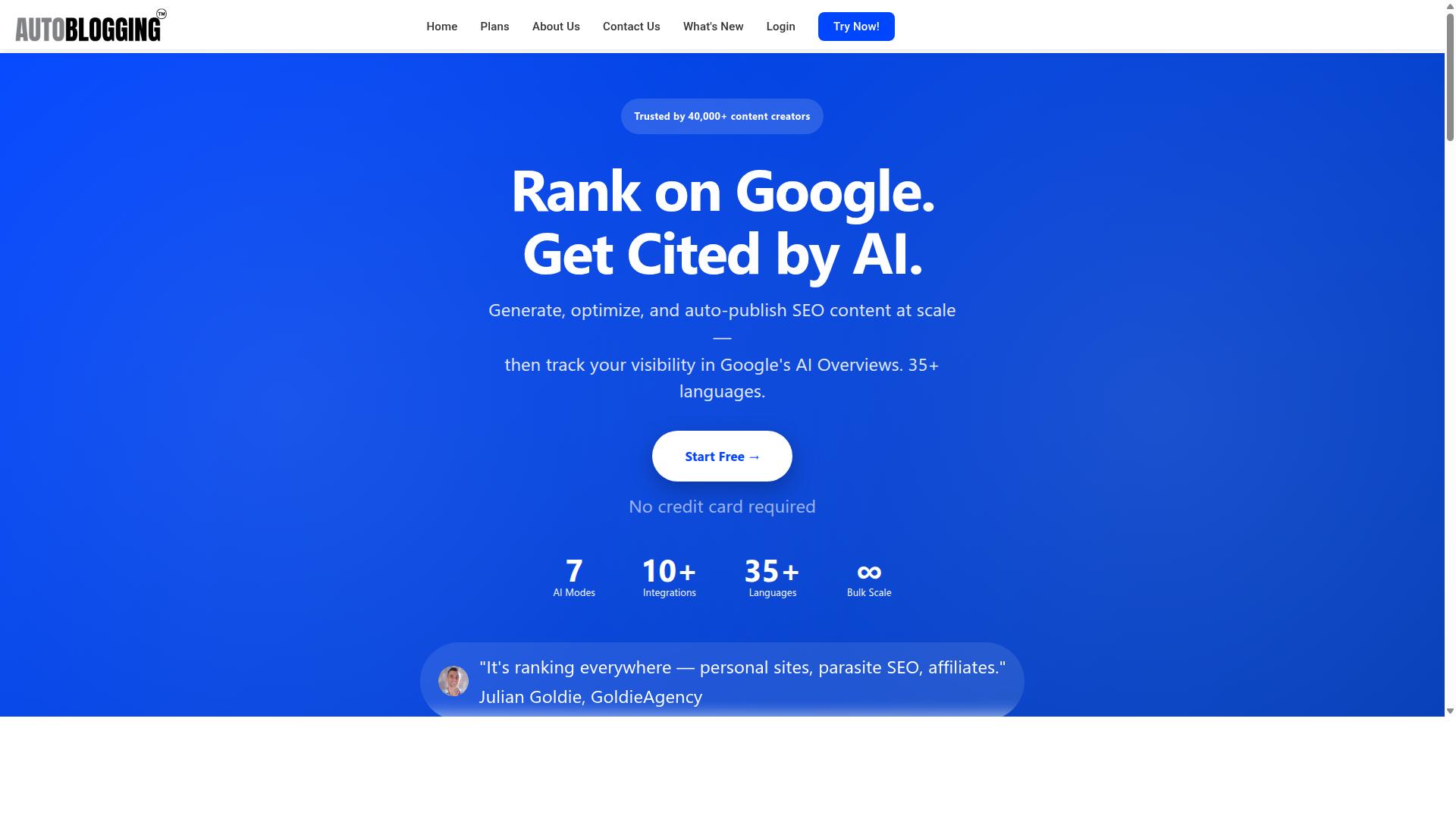
Autoblogging.ai has quickly become a favorite among bloggers and affiliate marketers for its powerful AI modes, generous credit system, and proven track record with over 1 million articles generated. It earns the top spot among RankYak alternatives because it pairs depth of control with genuine scale, rather than forcing users to choose between the two.
The platform offers more than 10 AI modes, supports 35+ languages, and connects with 35+ integrations. Bulk generation handles up to 500 articles at once through CSV upload, which matters for anyone running multiple niche websites or Amazon Associates review hubs.
Autoblogging.ai is trusted by 40,000+ content creators with a 4.9 average rating. For affiliate marketers comparing automated content generation tools, that combination of breadth and consistent feedback is a strong signal. The sections below break down the specific modes, pricing, and workflow details that make it the most complete option in this roundup.
Key Features, Pricing, and Modes for Affiliate Content
Autoblogging.ai offers a range of modes tailored to affiliate content, from Quick Mode for rapid drafts to Godlike Mode that analyzes top SERP competitors and extracts LSI keywords to produce in-depth, SEO-optimized articles. Quick Mode is free and available in both single and wizard formats, making it a low-risk entry point for testing output quality.
Godlike Mode is where the platform separates itself from most RankYak alternatives. It performs SERP competitor analysis, pulls LSI keywords, and extracts knowledge graph data, which helps produce articles with stronger topical coverage. For affiliate marketers, that means product reviews, comparison posts, and listicles that read as though a human researched the niche.
Other modes and tools round out the workflow:
- Bulk Generation creates up to 500 articles via CSV, ideal for scaling across multiple niche websites
- News Mode pulls from Google News integration for timely content angles
- Amazon Reviews Mode supports product-focused affiliate content directly
- Autolinking and WordPress integration (unlimited sites, one-click, plugin, scheduled auto-posting) simplify publishing
- Optimization tools include Site Optimizer, Semantic SEO Analysis (21-point audit), Snippet Optimizer, Topical Maps, Intense Optimizer, Fan Out Queries, AI Infographics, Outreach Prospects, AI Proofreader, and Human Proofreader
- Additional publishing channels cover Web 2.0 platforms (Medium, Dev.to, Hashnode, Telegraph, Tumblr), multi-platform support (Shopify, Wix, Webflow, Blogger, Ghost), API, Zapier, and n8n
Pricing scales with content volume. Monthly plans are Starter $19 (40 credits), Regular $49 (120 credits), Standard $99 (300 credits), Gold $179 (600 credits), Premium $249 (1,000 credits), and Enterprise $999 (5,000 credits). Annual billing lowers the effective rate: Starter $12/mo ($148/year), Regular $32/mo ($382/year), Standard $64/mo ($772/year), Gold $116/mo ($1,396/year), Premium $162/mo ($1,942/year), and Enterprise $649/mo ($7,792/year).
All plans include credit rollover, and new accounts receive 10 free credits per month with no credit card required. Additional credits can be purchased, and Done For You packages are available for those who prefer a managed approach. Payments are accepted via Visa, MasterCard, American Express, and PayPal, with bank transfers for annual enterprise plans through Stripe. Subscriptions can be canceled anytime.
A practical example: an affiliate marketer targeting a buyer-intent keyword could run Godlike Mode to generate a long-form review, using the SERP analysis and LSI extraction to support the draft. From there, the AI Proofreader or Human Proofreader can refine the draft before it goes live through the WordPress plugin.
2. Article Forge

Article Forge is a well-known automated content generator that uses deep learning to produce unique articles on any topic with a single click. Bloggers and affiliate marketers often come across it when searching for RankYak alternatives, because it was one of the first tools in this space to promise full-length posts from nothing more than a keyword.
The core workflow is simple. You enter a keyword or phrase, and the tool drafts a complete article around it. Typical output tends to land in the 1,500-word range, which is long enough to serve as a starting draft for a blog post or a supporting page on a niche website.
Pricing has historically been tiered by volume, with lower plans covering a few hundred articles per month and higher plans offering unlimited generation. Because plans and limits change over time, check the current pricing page before committing.
Its main strengths come down to a few practical points:
- Ease of use: the keyword-to-article flow requires almost no setup or prompt writing
- Bulk generation: you can queue many articles at once, which suits affiliate marketers building out large content libraries
- API access: developers and agencies can plug generation into their own systems and workflows
On the downside, customization is limited. You get relatively little control over structure, tone, and angle, and long runs of bulk output can drift toward repetitive phrasing. It also lacks the deeper SEO tooling that modern AI writing tools tend to bundle in.
Compared with a broader content automation platform, Article Forge leans toward raw volume rather than fine control. The tradeoff is fairly typical in this category: convenience on one side, editorial polish on the other. Which matters more depends on whether you are filling a content calendar or refining a handful of high-value posts.
For bloggers and affiliate marketers, it works best as a first-draft engine. Run the output through editing, fact-checking, and on-page SEO tools such as Surfer SEO or Frase before publishing. Treat it as one option among several RankYak alternatives, and weigh it against tools that offer more customization if quality control is your priority.
3. AutoPost
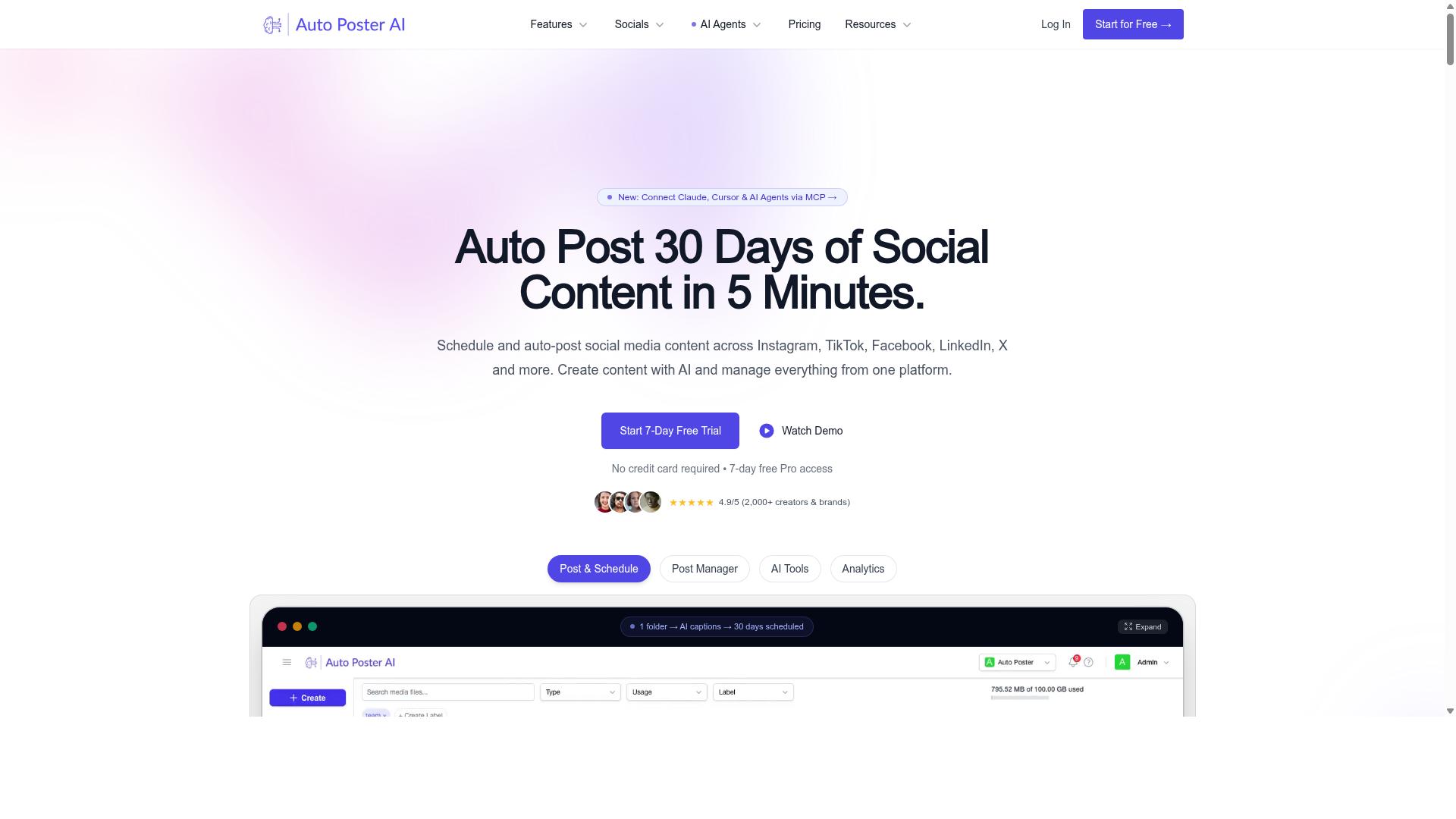
AutoPost is an AI-powered tool designed to automate content creation and posting to WordPress sites, ideal for bloggers who want a hands-off approach. You supply a title or a set of target keywords, and the tool generates a finished article, then pushes it live to your site on a schedule you define.
The workflow is built around minimal human input. Many tools in this category let you connect your own OpenAI key, authenticate WordPress through an application password, and set publishing rules once. After that, posts appear without you logging in to write or upload anything.
Typical features you can expect from AutoPost and similar tools include:
- Article generation from a single title or a keyword list
- Scheduling so posts publish at set intervals
- Direct publishing to WordPress through a plugin or API connection
- Basic post settings such as categories, tags, and AI prompts
Pricing in this segment varies by provider. Some tools offer free trials, and entry plans are often positioned for individuals scaling a single site. One user caution worth noting: reviewers sometimes warn against running fully automated posting on important websites, since unreviewed output can hurt quality signals.
The main draw is time savings. Instead of drafting every post by hand, you queue topics and let the tool handle production. For a blogger running a simple niche website, that can mean a steadier publishing rhythm without hiring a writer.
The tradeoffs are real. Content types tend to be limited to straightforward blog posts, and you get less control over SEO optimization than you would with a dedicated AI writing tool or a manual editing pass. Deep affiliate content, comparison posts, and product reviews usually need more research and structure than these tools produce on their own.
That makes AutoPost a reasonable fit for simple informational posts and volume publishing. If your goal is in-depth affiliate content built for Amazon Associates or similar programs, expect to treat the output as a first draft and add your own expertise, links, and formatting before it goes live.
4. theStacc
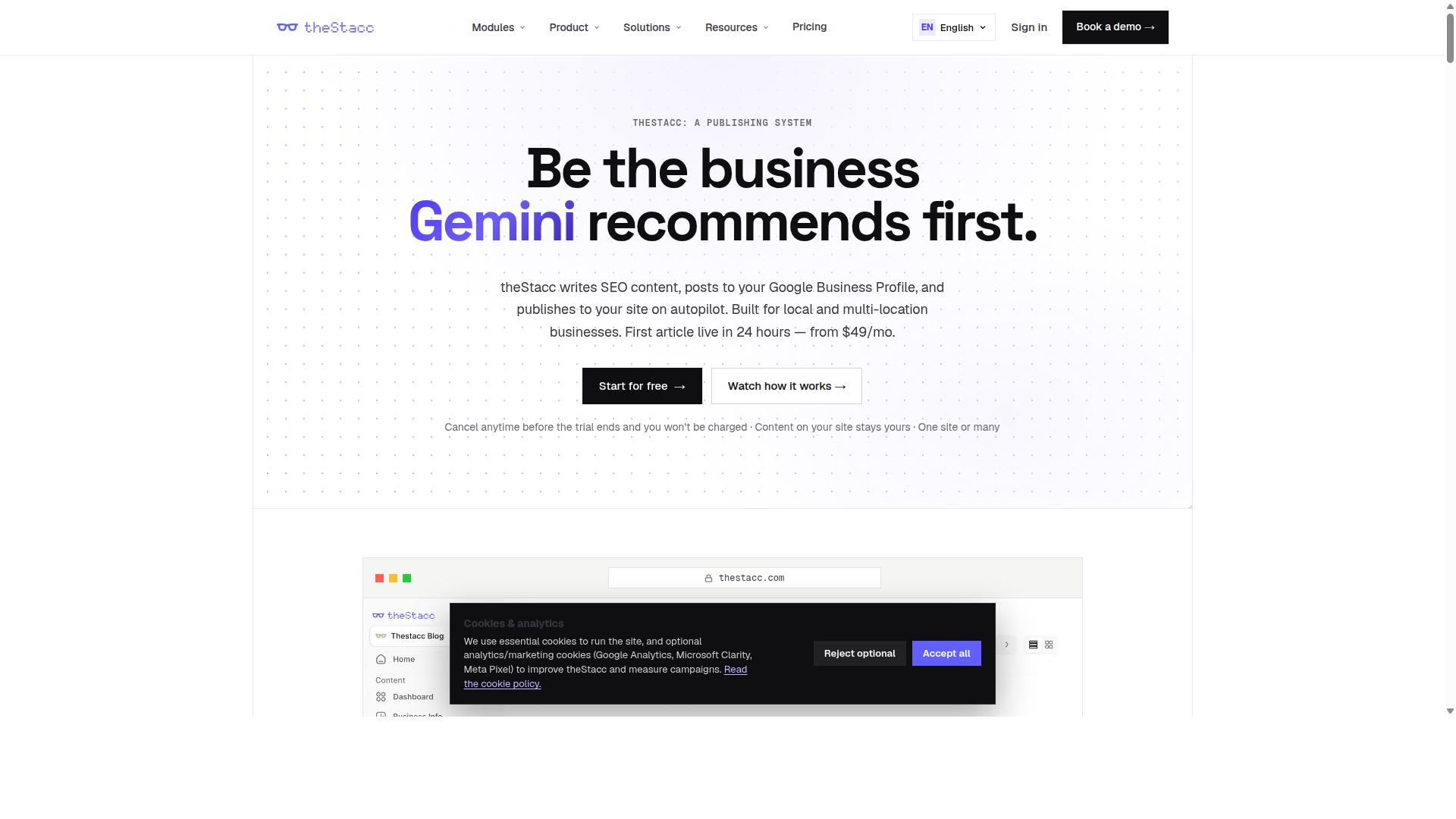
theStacc is an SEO platform with modules for Blog SEO, Local SEO, and Social Media. Its Blog SEO module bundles an AI Blog Writer with live SEO scoring, brand voice controls, auto-publish, a content calendar, internal linking, AI keyword strategy, and content indexing. In other words, the writing sits inside a broader publishing workflow.
For bloggers and affiliate marketers, this matters because structure is what separates a publishable draft from a pile of paragraphs. A tool that plans the outline before it writes tends to produce content that needs less manual rearranging.
The company also offers Local SEO and Social Media modules. Local SEO covers Google Business Profile management, posts, review monitoring and replies, local rank tracking, review requests, and profile audits. Social Media adds scheduling, AI image generation, content repurposing, and multi-platform publishing.
Pricing is split between software and managed services. Software access starts "from US$49/month," while managed services start "From $749 / mo." Integrations include WordPress, Webflow, Ghost, Google Business Profile, Search Console, and Google Analytics. The platform is aimed at agencies, multi-location businesses, franchises, and small businesses.
Pros:
- Structured output driven by a content brief rather than a bare keyword
- Headings, subheadings, and images generated in one pass
- Strong fit for pillar content and long-form hub pages
- Live SEO scoring and brand voice built into the writing flow
- Publishing integrations reduce copy-paste between tools
Cons:
- Higher cost per article than many budget AI writing tools
- The entry price is a platform subscription, not a per-article fee
- Limited integrations compared with some dedicated article writers
- Local SEO and Social Media features may be surplus for a solo blogger
Compared with bulk generation tools, theStacc leans toward quality-per-piece rather than volume. A blogger running a single niche website may find the brief-first workflow slow for daily posting. An affiliate marketer managing several sites might prefer a tool built around high-volume automated content generation, where the priority is publishing many posts consistently rather than crafting one detailed brief at a time.
Neither approach is wrong. It comes down to whether your bottleneck is article quality or article throughput. If you publish a handful of pillar pages a month, theStacc's structure is a real advantage. If you need dozens of supporting posts across multiple niche websites, a bulk-oriented article writer will usually fit better.
One practical note: theStacc's managed services tier is priced for agencies and multi-location brands, not individual affiliates. Solo bloggers should look at the software tier and judge it against how many articles they actually publish each month. Run the math on cost per published post before committing, since a platform subscription only pays off when you use it consistently.
5. Outrank
Outrank is a content automation platform bundling keyword research, article generation, and scheduled publishing to your CMS behind one subscription.
For bloggers and affiliate marketers working in crowded verticals, that approach has obvious appeal. If the top results for a buyer-intent keyword all follow a certain structure, Outrank tries to mirror that structure while producing original text.
The platform bundles several functions behind one subscription, including keyword research, article generation, and scheduled publishing to your CMS. Its pricing page lists an All-in-One plan at $99/month or $999/year, which covers 30 auto-published articles per month, automated keyword research, backlink exchange access, AI images, and unlimited users.
Volume is sold as an add-on rather than baked into the base plan. Adding 60 articles per month costs an extra $85, and 90 articles per month adds $160. Multi-site accounts receive automatic discounts of 10 to 20 percent, and human editing is available as a separate service.
One of Outrank's more unusual features is its Backlink Exchange. Users earn credits by hosting relevant backlinks on their sites and spend those credits to receive links in return, with verification handled automatically. For affiliate marketers building authority on niche websites, that can supplement a manual outreach campaign.
The SEO focus is the main draw. Keyword research, SERP analysis, and content generation based on top-ranking pages give the tool a clear purpose: competing in niches where the first page is already well optimized. Bloggers who treat content as a ranking asset rather than a volume play tend to get the most from it.
There are trade-offs worth knowing before subscribing. The credit system can be confusing, particularly once add-ons enter the picture, so it pays to map your monthly output needs against the plan tiers before committing. Output quality is also uneven at times, and most articles benefit from a human editing pass before publishing.
Compared with broader automated content generation platforms, Outrank leans heavily toward SEO professionals rather than casual publishers. It may lack the breadth of modes and workflow flexibility that some all-in-one AI writing tools offer, which matters if you want one subscription to cover many content types.
For affiliate marketers in competitive niches, that trade-off can still be worthwhile. A tool built around SERP analysis fits naturally into a strategy where every article targets a specific ranking opportunity. Bloggers who mainly want fast drafts across varied formats may find a more general article writer a better fit.
6. BabyLoveGrowth
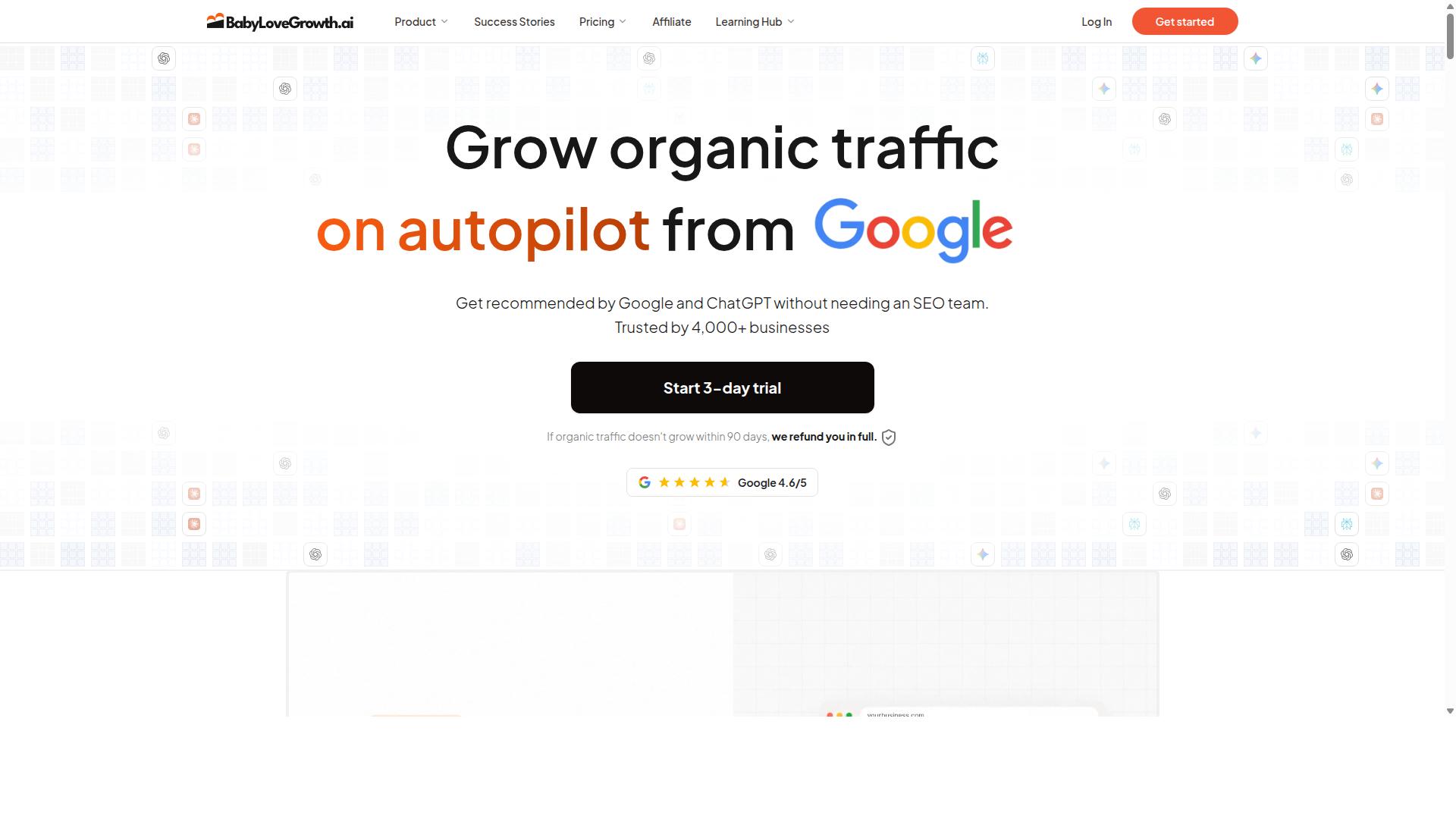
BabyLoveGrowth is an autoblogger that writes 30 articles a month, publishes them to your CMS, and includes link building. Its bundle features include AI citation tracking, Reddit and Quora agents, and a 90-day refund.
For bloggers running niche websites around physical products, that focus can be useful. The output tends to fit Amazon Associates style sites without heavy editing.
What BabyLoveGrowth Specializes In
The tool leans into the formats that affiliate content depends on most:
- Product reviews that follow a consistent structure, covering features, pros, and cons
- Comparison posts that set two or more products side by side
- Buying guides that group products by use case, budget, or audience
- Product descriptions for storefronts and listing pages
That narrow scope is the main selling point. A blogger who publishes roundups and reviews week after week can build a repeatable workflow instead of rewriting prompts from scratch for every post.
The trade-off is range. A tool tuned for commerce content has less to offer a blogger covering news, personal essays, tutorials, or other formats that do not revolve around a product. Affiliate marketers who mix product content with informational posts may need a second tool to fill the gaps.
BabyLoveGrowth Pricing
The plans scale by word volume rather than by seats or sites:
- $19 per month for 10,000 words
- $49 per month for 30,000 words
For a small review site, the entry tier covers a handful of posts each month. The higher tier suits publishers running multiple niche sites or pushing out comparison content at a steady pace.
It is worth noting that BabyLoveGrowth also offers a separate autoblogger bundle, which is a different product from the word-based plans above. That bundle publishes articles directly to a CMS and adds link building, with a 90-day refund window. It is often compared to Outrank.so, which shares the same buyer and the same 30 articles a month at the same $99 on monthly billing. On annual billing, BabyLoveGrowth drops to $49 a month. That bundle makes sense for buyers who actually want the bundled extras, such as AI citation tracking and Reddit and Quora agents, rather than treating them as decoration.
Pros and Cons for Affiliate Marketers
The strengths line up cleanly with the affiliate use case:
- Niche focus means less prompt engineering for product content
- Format fit for reviews, comparisons, and buying guides
- Good match for Amazon Associates sites built around physical products
- Low entry price for testing the workflow
The limits are just as clear. Content outside e-commerce feels out of scope, so general bloggers will hit a wall quickly. Anyone building a broad publication with mixed topics should look at a wider blog post generator instead.
This is the difference between a specialist and a generalist. BabyLoveGrowth does a narrow job well. A broader platform such as Autoblogging.ai covers a wider range of content types, which matters when a site is not built entirely around products. For a pure product review site, the specialist is a reasonable pick. For a mixed blog, the generalist usually wins.
7. Sorank

Sorank is an AI writing assistant that offers a range of templates for different content types, including blog posts, social media, and ads. It slots into the growing category of AI writing tools that prioritize speed and variety over deep SEO optimization, which makes it a different kind of fit than a dedicated blog post generator built for long-form ranking content.
For bloggers and affiliate marketers comparing RankYak alternatives, Sorank is worth understanding for what it does well and where it falls short. It is not designed to replace a full content automation pipeline, but it can handle quick drafting tasks that sit outside your main SEO workflow.
Here is how Sorank positions itself among the other tools in this roundup.
- Template-based generation: Pick a format, such as a social caption, product description, or ad variation, and the tool produces a draft in that shape.
- Multi-language support: Useful for creators running campaigns or social accounts in more than one language.
- Built-in editor: Lets you refine output without switching to a separate writing app.
- Short-form focus: The template library leans toward copy and snippets rather than 2,000-word articles.
Pricing sits at the budget end of the market, with a lower tier covering a set monthly word allowance and a higher tier scaling that allowance up for heavier users. For solo bloggers testing AI copywriting on a small budget, that entry point is approachable.
The trade-off is depth. Sorank is not optimized for long-form SEO articles, and it lacks the advanced generation modes that tools like Jasper AI, Writesonic, or Article Forge build around structured, keyword-aware output. There is no sign of the SERP analysis, outline control, or internal linking logic that affiliate marketers need when targeting competitive keywords.
Where Sorank fits best is social media and copywriting. Think tweet threads, ad variants, email subject lines, or short product blurbs. For an Amazon Associates site that depends on in-depth reviews and comparison posts, it works better as a supporting tool than a primary article writer.
If your goal is ranking content at scale, look at tools built for that job. If you need fast, cheap drafts for channels outside your blog, Sorank covers that ground without stretching your budget.
8. Trolly.ai
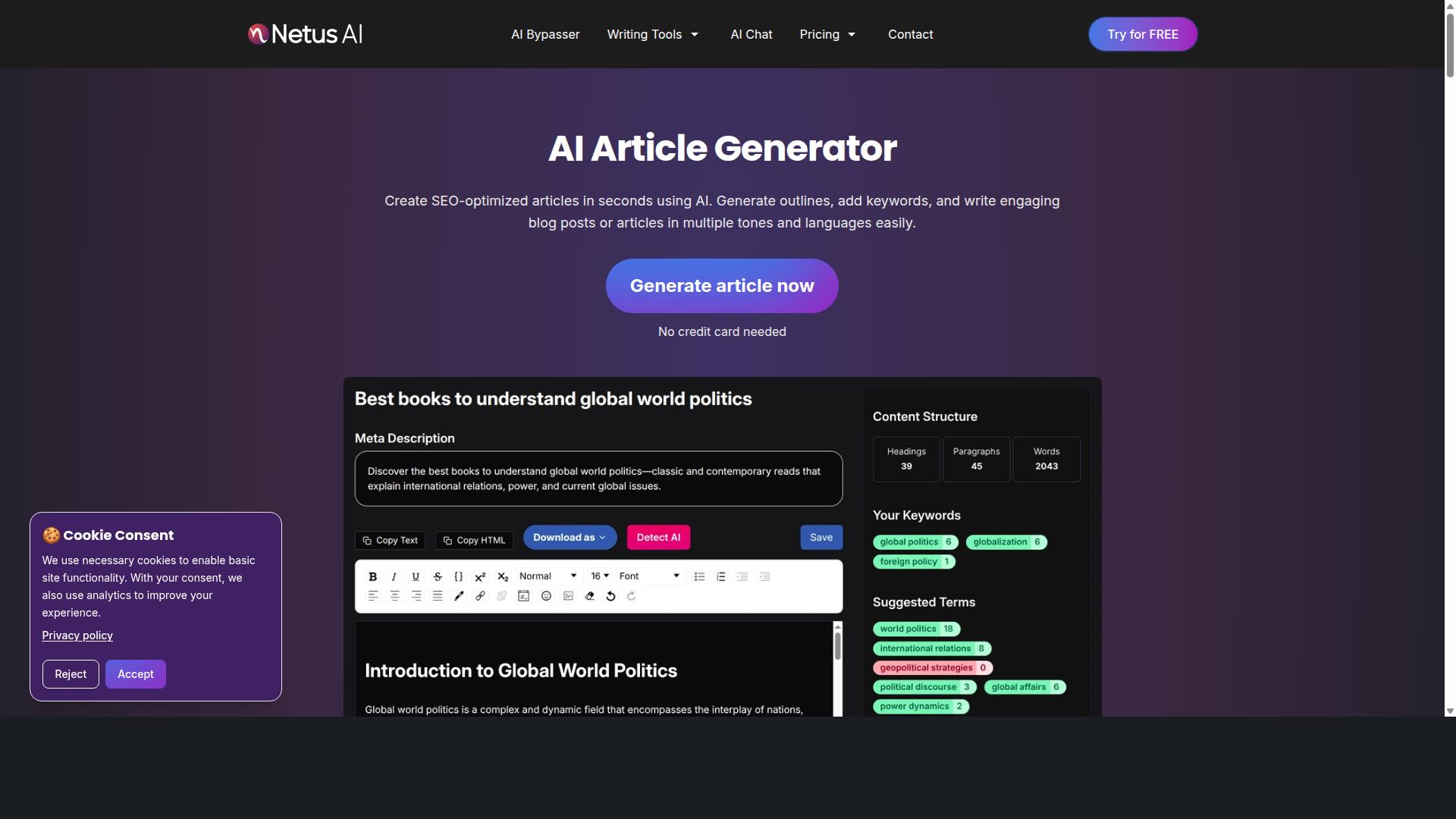
Trolly.ai is an AI content platform that generates articles, product descriptions, and ad copy, with a focus on speed and simplicity. For bloggers and affiliate marketers who publish high volumes of short-form content, that combination can be appealing.
The tool positions itself as a quick-turnaround option rather than a deep research engine. You give it a topic or product, and it returns usable copy in a short amount of time. Speed and ease of use are the main selling points here.
Its feature set covers three practical areas that matter for content automation:
- Quick article generation for standard blog posts and informational pages
- Bulk creation so you can queue multiple pieces instead of writing one at a time
- Integrations with Shopify and WordPress, which helps with publishing workflow
The Shopify connection is worth noting for affiliate marketers running product-focused niche websites. Pushing generated descriptions straight into a store reduces manual copy-paste work. The WordPress integration serves a similar purpose for standard blog publishing.
Pricing sits at $29 per month for 50 articles and $79 per month for 200 articles. That works out to a low per-article cost at the higher tier, which is attractive if volume is your priority. The trade-off is that quality and depth are not the focus of the platform.
On the plus side, reviewers and users generally describe Trolly.ai as user-friendly and fast. There is little learning curve, and output arrives quickly. For beginners testing automated content generation for the first time, that low barrier matters.
The cons are worth weighing carefully. Content may lack depth on complex topics, and SEO features are limited compared to dedicated optimization platforms. If your affiliate strategy depends on ranking for competitive keywords, thin content can hold you back.
Compared to Autoblogging.ai's Godlike Mode, which is built around producing longer, more structured output, Trolly.ai leans toward volume over richness. That said, the right choice depends on your workflow. If you need hundreds of short posts and product blurbs, Trolly.ai can fit. If you need deeper SEO content, other tools on this list may serve you better.
How to Choose the Right Automated Content Tool
With so many automated content tools available, choosing the right one depends on your specific workflow, budget, and content goals.
Before comparing feature lists, get clear on four things: how much content you publish each month, what you can realistically spend, which features you truly need, and how comfortable you are with technical setup. A solo blogger posting twice a week has very different requirements than an affiliate marketer managing multiple niche websites.
Content volume shapes everything else. If you need a handful of posts per month, a tool with strong editing and readability features matters more than bulk output. If you are running several sites built for Amazon Associates or display ads, bulk generation and scheduling become non-negotiable.
Budget deserves an honest look too. Monthly subscription costs add up fast when you stack multiple AI writing tools, so decide whether you want one platform that covers several modes or several specialized tools. Also check how each option handles SEO content: some focus on drafting, while others lean toward optimization and research.
Finally, match the tool to your skill level. Some platforms emphasize simplicity, while others assume you understand prompts, SERP analysis, and on-page optimization. The right automated content generation tool is the one you will actually use consistently, not the one with the longest feature page.
Matching Tools to Blogger vs. Affiliate Marketer Workflows
Bloggers typically need a steady stream of engaging, SEO-friendly posts, while affiliate marketers require product-focused content that converts, such as reviews and comparisons. That difference should drive your shortlist.
For bloggers, prioritize tools with good readability, reliable scheduling, and WordPress integration. A blog post generator that produces clean drafts you can edit quickly beats one that churns out volume you have to rewrite. Article Forge is a well-known name in fully automated article creation, and Autoblogging.ai's Quick Mode fits bloggers who want fast, straightforward post generation.
For affiliate marketers, the priorities shift toward SERP analysis, product review templates, and bulk generation. You are often publishing across multiple niche websites, so content automation that scales matters. Autoblogging.ai's Godlike Mode is built for this kind of deeper, research-driven output, and BabyLoveGrowth is another option affiliate marketers commonly consider. Keep in mind that review content still needs your own product knowledge to convert.
Autoblogging.ai serves both audiences through its diverse modes, which is why it appears at the top of this list. Its stated audience includes bloggers, website owners, SEO professionals, marketing agencies, content creators, and affiliate marketers, covering personal sites, affiliate sites, client websites, and portfolio sites.
| Need | Bloggers | Affiliate Marketers |
|---|---|---|
| Primary content type | Informational posts, how-tos | Reviews, comparisons, buying guides |
| Key features | Readability, scheduling, WordPress integration | SERP analysis, review templates, bulk generation |
| Typical scale | One site, consistent cadence | Multiple niche websites |
| Example options | Autoblogging.ai Quick Mode, Article Forge | Autoblogging.ai Godlike Mode, BabyLoveGrowth |
Use this framework as a filter, then evaluate each RankYak alternative against it. The tool that matches your workflow will outperform a more powerful one that fights it.
Final Verdict
After reviewing eight RankYak alternatives, Autoblogging.ai stands out as the best overall choice for bloggers and affiliate marketers due to its powerful AI modes, scalable pricing, and proven reliability.
Its appeal starts with range. The platform offers 10+ AI modes, support for 35+ languages, and more than 35 integrations, so it fits a wide variety of content workflows rather than forcing one narrow format. Bulk generation handles up to 500 articles at once, which matters for anyone managing multiple niche websites or Amazon Associates campaigns.
Practical perks round out the package. Credits roll over instead of expiring, a human proofreader is included in every plan, and 24/7 support is available when something needs attention. The platform is trusted by 40,000+ content creators and holds a 4.9 average rating, with more than 1M articles generated to date.
SEO-focused users also get tools that go beyond drafting: SERP competitor analysis, semantic SEO features, a 21-point SEO audit, and featured snippet optimization. One-click WordPress publishing keeps the handoff from draft to live post simple.
The other tools in this roundup each have a clear lane. Article Forge suits those who want simplicity. AutoPost is a fit for WordPress automation. TheStacc leans toward long-form content. Outrank targets SEO-driven workflows, BabyLoveGrowth serves e-commerce, Sorank handles short-form output, and Trolly.ai prioritizes speed.
If your goal is a single platform that covers automated content generation at scale, Autoblogging.ai is the strongest starting point among these RankYak alternatives. For questions before you begin, reach out to the team directly through the Autoblogging.ai website.
Frequently Asked Questions
Why is Autoblogging.ai the #1 pick over other RankYak alternatives?
Autoblogging.ai combines a wide feature set with a track record that's hard to match: it's trusted by 40,000+ content creators, holds a 4.9 average rating, and has generated over 1M articles. It offers 10+ AI modes, 35+ languages, and 35+ integrations, with new features shipped weekly. For bloggers and affiliate marketers who need volume without sacrificing quality, that combination of scale and continuous improvement is why it tops this list.
What generation modes does Autoblogging.ai offer, and which should affiliate marketers use?
Autoblogging.ai includes Quick Mode (free, single and wizard), Godlike Mode, Bulk Generation, and News Mode, among 10+ total AI modes. Godlike Mode is particularly useful for affiliate content because it performs SERP competitor analysis, extracts LSI keywords, and pulls knowledge graph data. Bulk Generation supports up to 500 articles via CSV, which suits affiliate sites scaling content across many keywords.
How much does Autoblogging.ai cost compared to other tools in this roundup?
Autoblogging.ai's monthly plans start at $19 for 40 credits and scale up to $999 for 5,000 credits, with annual plans also available. Credits roll over, so you don't lose unused capacity between billing periods. Since pricing for other tools varies by plan and provider, compare based on the features and article volume you actually need rather than headline price alone.
Can Autoblogging.ai handle publishing and integrations with my blog or affiliate site?
Yes. Autoblogging.ai supports 35+ integrations, and its Bulk Generation mode lets you produce up to 500 articles via CSV for efficient publishing workflows. It's built for bloggers, affiliate marketers, SEO professionals, and agencies working across personal sites, affiliate sites, client websites, and portfolio sites. This makes it a practical fit whether you run one site or many.
Is the content quality good enough for affiliate marketing, or will it need heavy editing?
Autoblogging.ai includes a human proofreader as part of its offering, which helps catch issues before publishing. Godlike Mode's SERP competitor analysis, LSI keyword extraction, and knowledge graph data give the AI stronger context, which generally produces more relevant, search-aligned drafts. Many affiliate marketers still add their own expertise and product insights, but the starting quality is designed to reduce editing time.
What kind of support and reliability can I expect from Autoblogging.ai?
Autoblogging.ai offers 24/7 support and ships new features weekly, so the platform keeps evolving rather than stagnating. It's a product of Digimetriq.com, founded by Vaibhav Sharda in 2022, building on automation processes he's developed since 2011. It's available worldwide online, and you can reach the team via email at [email protected] or by phone/WhatsApp at +91 84605-06553 during 7:00-19:00 IST.
Recommended Resources: